
 雷科技
雷科技
























On September 4, IFA 2026 officially opened in Berlin, Germany. As one of the world’s top three consumer electronics trade shows, this year’s IFA attracted over 1,900 exhibitors from 49 countries and regions, with the theme “The Future is Now.” The LeiTech IFA 26 Reporting Team (ID: LeiTech) is on-site in Berlin, delivering real-time, multi-dimensional, and first-hand coverage of IFA 2026.
Home appliances remain IFA’s core focus, and smart home solutions are ubiquitous across the IFA 2026 exhibition halls. Air conditioners now recognize people; refrigerators begin to understand food items; cameras proactively detect anomalies; robots roam freely around homes; and TVs, washing machines—even wall-mounted displays—are all competing to become the primary interface between users and their entire households.
The smart home landscape may look familiar—but much has changed. For years, manufacturers primarily tackled the question: “How do we connect more devices?” Standards such as Matter, Thread, and Zigbee—and gateways, apps, and ecosystem platforms—were all aimed at enabling interoperability among disparate devices. But at this year’s IFA, an increasing number of manufacturers are exploring a new question:
Once devices are connected, who—or what—truly understands the home?
UGREEN, Anker, and SwitchBot have opted to build a tangible, standalone hardware device serving as a home AI hub—or “home AI brain”—integrating local AI processing, storage, security, and device control into a single dedicated unit. Tuya and others have endowed their hubs with wheels and cameras, enabling them to actively sense environments across different rooms. Meanwhile, major appliance brands—including Midea, Hisense, Haier, and Samsung—are taking a more radical approach: embedding AI directly into refrigerators, air conditioners, TVs, washing machines, and the broader appliance ecosystem—effectively eliminating the traditional notion of a centralized hub.
So what kind of AI brain does the future home really need?
UGREEN / Anker / SwitchBot: A Dedicated Standalone Hardware Unit Housing the Entire Home AI Brain
When discussing a “home AI brain,” many recall the smart home gateways of a decade ago—a small box placed near the living room or utility cabinet to connect household devices. This time, however, what manufacturers have packed inside is entirely different.
Take UGREEN, for example: At IFA 2026, it extended its NAS business meaningfully into the smart home domain for the first time, unveiling the HomeAgent series—including the HA100, HA100 Pro, and the higher-tier MasterAgent MA100.
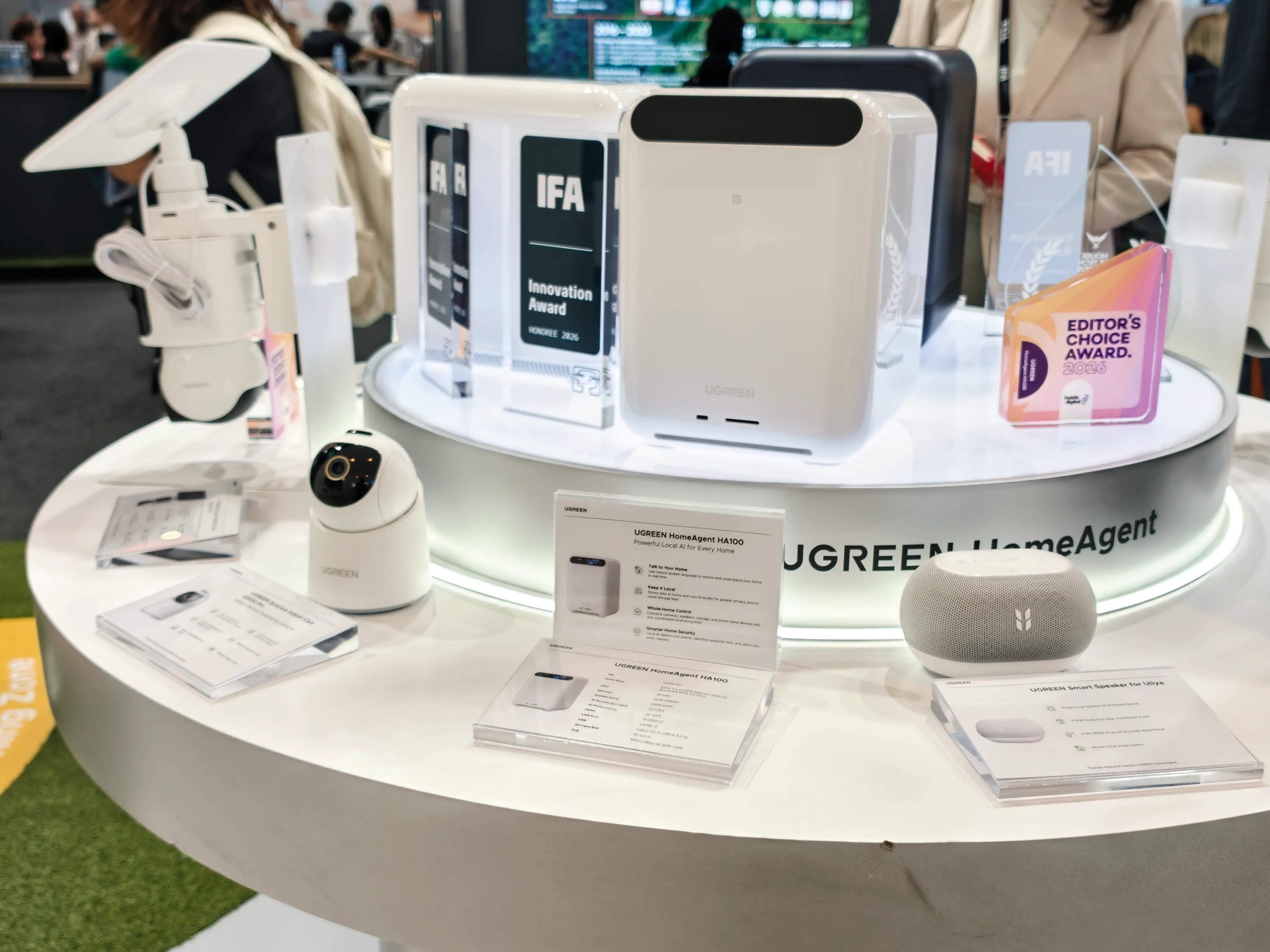
Image Credit: LeiTech IFA Reporting Team
These units function simultaneously as NAS devices, Matter-based smart home controllers, home security hubs, and local AI servers. They support multiple connectivity protocols—including Wi-Fi, Thread, and Zigbee—and ship with companion devices such as cameras, smart speakers, and digital photo frames. The flagship MA100 even features the NVIDIA Jetson Thor T5000 chip.
UGREEN’s rationale is straightforward.
In the past, family photos were stored on NAS devices; camera footage resided on NVRs; lighting, door locks, and sensors relied on smart home gateways; and AI processing ran exclusively in the cloud. UGREEN now aims to consolidate all these functions into a single device.
With on-device AI, the system can identify people, pets, and packages; interpret video feeds from connected cameras; enable natural-language search across home videos and photos; and directly translate insights into smart home automations—for instance, detecting a child’s return home and triggering lights, adjusting the air conditioner, or sending a notification. Much data previously uploaded to the cloud can now be processed and retained locally.
In other words, NAS is evolving—from simply “storing household data” to actively “understanding household data.”
Anker’s newly launched MindBase follows a similar philosophy—but with a subtly different strategic intent.
MindBase integrates a 26 TOPS AI compute unit and runs the TrueSmart Agent platform. It also serves as a Matter 1.5 controller supporting Wi-Fi, Bluetooth, Thread, and Zigbee, and offers expandable local storage up to 48 TB. Anker claims MindBase can connect to nearly 100 of its own devices—and hundreds of third-party Matter-certified products.
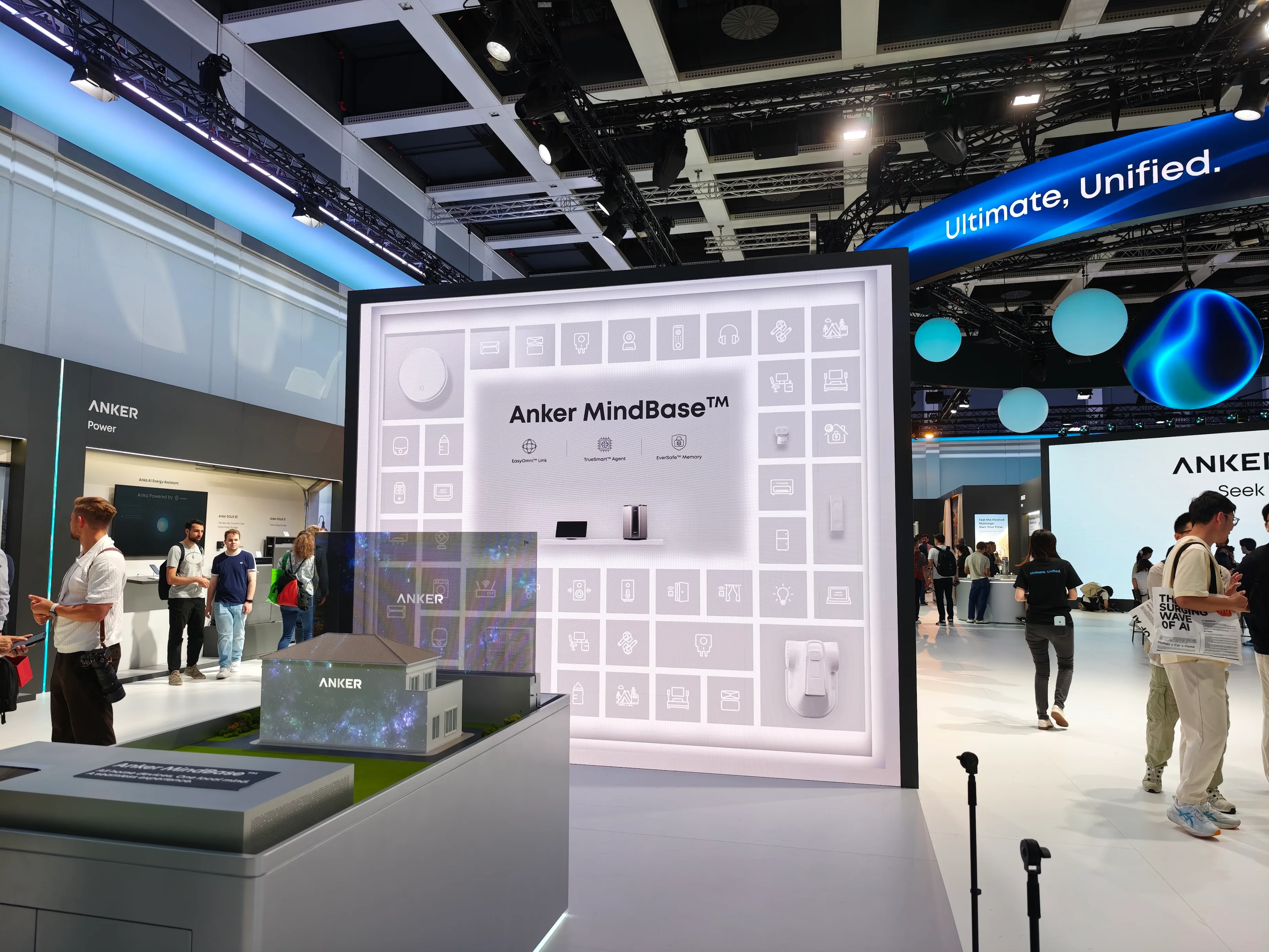
Image Credit: LeiTech IFA Reporting Team
According to Anker’s presentation, MindBase’s initial capabilities center strongly on security. When cameras or radar sensors detect anomalies, MindBase performs local risk assessment and decides whether to record video, activate lights, or alert users. Users can also perform natural-language searches of recorded footage. The bundled MindBase Security Kit further integrates cameras, doorbells, and radar sensors.
Yet Anker clearly intends to go well beyond security.
Over recent years, Eufy has handled cleaning and security; Solix has focused on residential energy management; and Anker itself has offered extensive product lines covering charging, audio-visual equipment, and more. This year, Anker consolidated multiple sub-brands under the unified banner “Anker for Home.” MindBase marks the first time these seemingly independent hardware ecosystems share a common AI brain.
The convergence of UGREEN and Anker’s paths is intriguing.
One company originally sold NAS devices; the other long specialized in power adapters and standalone peripherals. Yet both have realized: as the number of home devices and associated data grows—and as AI demands stable, local compute resources—a permanently powered, always-on computing node has re-emerged as a necessary fixture within the modern home.
SwitchBot, another China-based manufacturer targeting overseas markets, takes yet another path. Its AI Hub concept was first introduced at last year’s IFA. Following its February launch—which added OpenClaw support—the AI Hub has now matured into a fully functional, purchasable, and deployable home AI solution at this year’s IFA.
SwitchBot equipped the AI Hub with a 6 TOPS AI chip capable of running local automations and managing cameras. It supports Home Assistant, Frigate, and third-party RTSP-compatible cameras. Crucially, it treats the camera as the “eyes” of the home AI system.
Compared to traditional smart home systems relying mainly on discrete sensors—where a door sensor only reports “door open” and a motion sensor merely signals “someone passed by”—integrating cameras with VLM (Vision-Language Models) enables AI to comprehend full contextual events: “Who just returned home?” “Where did the cat run?” “Did the elderly person fall?”—and then intelligently decide which devices to engage next.
Beyond OpenClaw integration—which lets users invoke the AI Agent via messaging platforms like WhatsApp, iMessage, and Discord—SwitchBot also supports cross-ecosystem control across Apple Home, Google Home, and Home Assistant.
Similar shifts are appearing across other products. Security brand Reolink (RuiLian) unveiled its Home Hub 2 at IFA 2026, and its new ReoNeura AI is beginning to interpret increasingly specific home scenarios.
Even some “home AI brains” are moving onto walls. Shelly (Shelly Smart Home) announced at IFA 2026 that existing Wall Display units will become both Matter controllers and Matter-enabled devices following a free firmware update. Third-party Matter devices—including lights, blinds, and thermostats—can now connect directly to the wall-mounted display for local control and automation—eliminating the need for a separate gateway.
LG’s Homey brand likewise introduced the Portal—a compact 2.8-inch circular touchscreen designed for placement in kitchens, living rooms, or bedrooms, acting as the central control interface for the entire Homey smart home ecosystem. While underlying computation still relies on the Homey Pro hub, cloud services, or self-hosted servers, the “AI brain” and “control interface” are now decoupled.
The resurgence of these standalone home hubs stems from relatively simple drivers.
Matter has progressively solved inter-device connectivity challenges, while local AI is now tackling understanding and decision-making. Data siloed across cameras, sensors, and NAS units finally has a chance to be unified.
Still, after manufacturers invest significant effort in building smarter hubs, another group of companies is already asking a different question:
Does the “home AI brain” truly require a fixed physical terminal?
Tuya and Others Embed the Home AI Brain Into Robots That Roam Throughout the House
Standalone hardware-based home AI hubs certainly offer advantages—but any hub placed on a desk, mounted on a wall, or tucked into a utility cabinet faces an inherent limitation: it struggles to perceive what happens in every corner of the home.
A camera may monitor the living room; millimeter-wave radar may detect presence in the bedroom; and a door sensor may report when a door opens—but these sensing modalities remain fragmented. At this year’s IFA, however, an alternative “home brain” emerged: equipping it with wheels, cameras, and microphones so it moves autonomously throughout the house.
Tuya’s newly launched Doova exemplifies this direction.
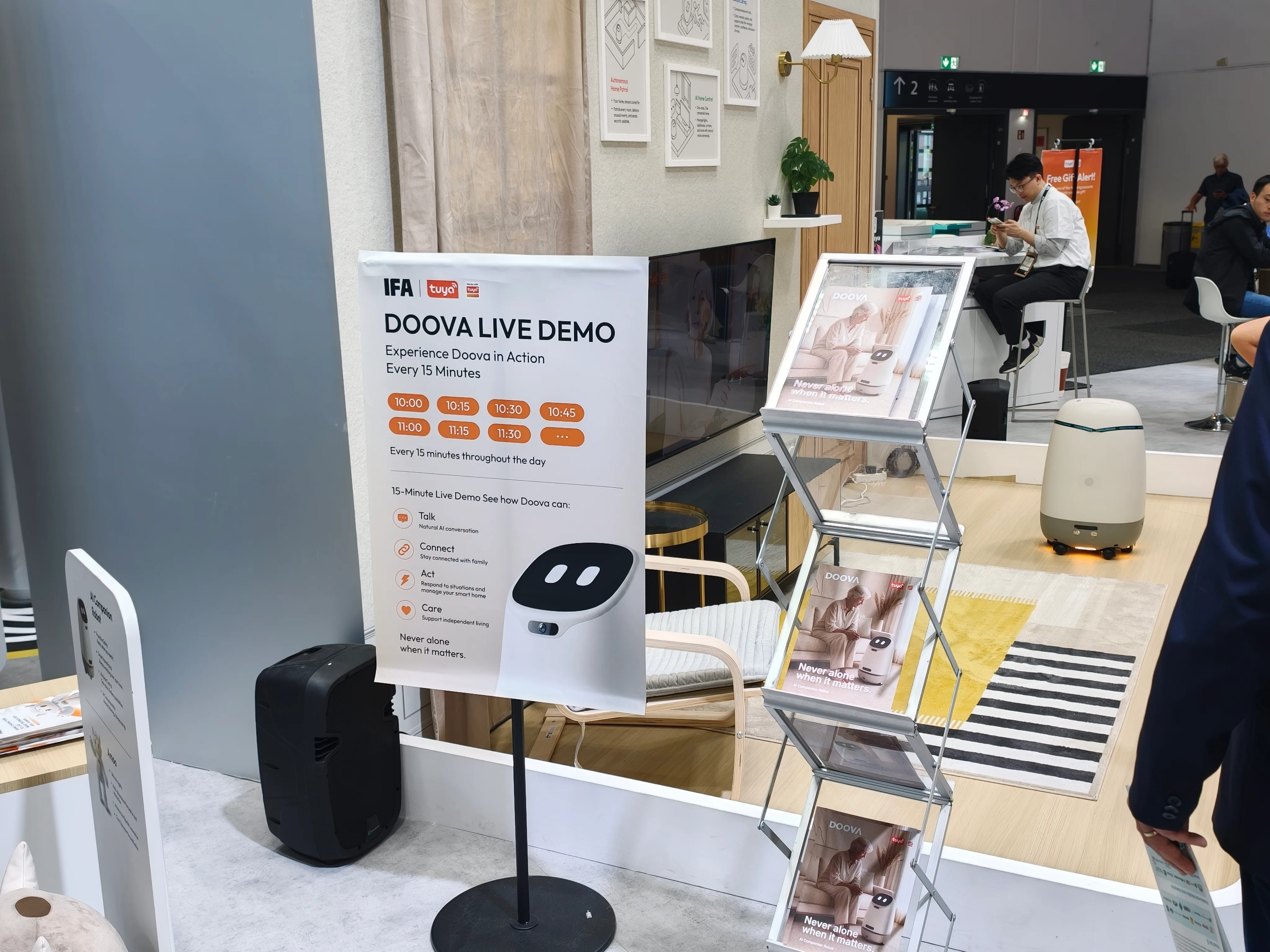
Image Credit: LeiTech IFA Reporting Team
This AI companion robot targets seniors living alone. Its form factor resembles a wheeled robot with an integrated display, complemented by LiDAR, quad-microphone sound-source localization, and vision-based skeletal recognition—enabling autonomous navigation indoors.
For example, if an elderly user falls and calls for help, Doova locates the sound source, navigates to their side, and verifies their condition. If no response is received within 60 seconds, it initiates an emergency protocol—initiating a two-way video call with family members. When the user is away, Doova autonomously patrols different rooms, performing 360-degree environmental scans and generating comprehensive home safety reports.
Simultaneously, Doova functions as a mobile smart home hub.
It integrates seamlessly into Tuya’s AIoT ecosystem, enabling voice control of lights, blinds, kitchen, and bathroom appliances. Underpinning this is Hey Tuya—a multimodal large model framework connecting AI Agents with Matter devices—allowing users to issue natural-language commands that are more ambiguous and conversational.
Historically, one of the biggest pain points with home hubs was their ability to track device states—yet inability to truly grasp the real-world home environment.
A mobile robot perfectly bridges this gap. Equipped with cameras, microphones, and LiDAR, it sees, hears, knows its location, and can actively approach people or enter different rooms. Compared to a stationary corner-mounted camera, its environmental awareness is inherently richer and more holistic.
This represents a key driver behind the convergence of home robots and home AI hubs.
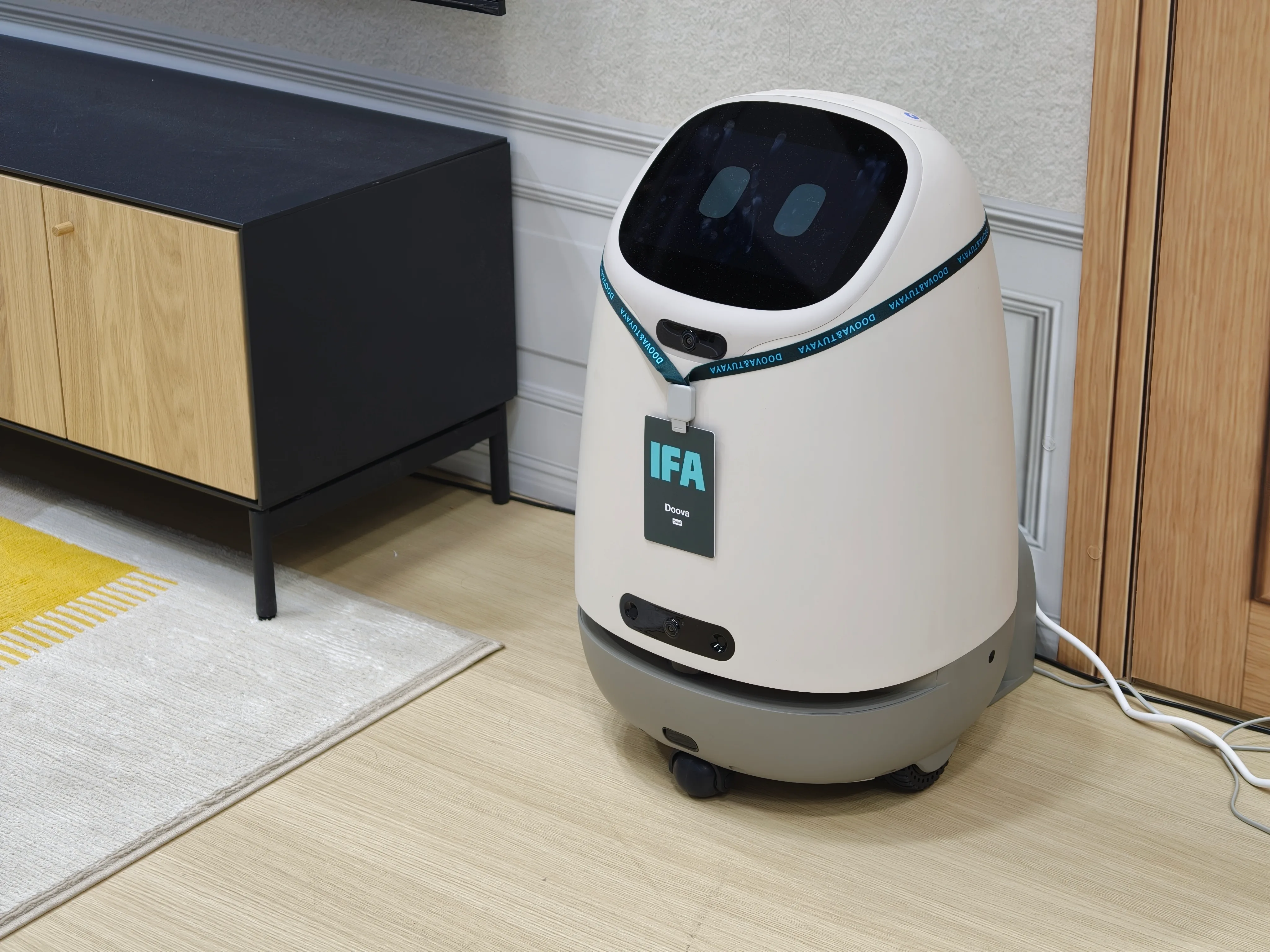
Image Credit: LeiTech IFA Reporting Team
Conversely, for robots to genuinely integrate into homes, they must understand spatial layouts, recognize people, remember environments, and coordinate with other household devices. Meanwhile, AI hubs aiming to evolve beyond mere “device control” toward true “home understanding” lack an active, mobile sensory interface. As both sides advance, convergence becomes inevitable.
Even earlier, SwitchBot’s K20+ Pro demonstrated similar thinking—mounting cameras, air purifiers, and other modules onto robotic vacuum bases to serve as mobile surveillance and multifunctional home assistants. Product forms may differ, but the underlying logic remains consistent:
Since robotic vacuums already autonomously navigate the entire home daily, why not extend their role to become mobile sensors—or even mobile execution nodes?
However, a common misconception arises here: mobility doesn’t imply the home requires a humanoid robot as a “butler.”
In fact, LG prominently featured its CLOiD domestic robot at IFA’s AI Home exhibition zone—positioning it as the conductor of its “zero-labor home.” Midea also showcased various robots advancing AI Agents from software into the physical world to handle domestic chores.
But industry giants like LG and Midea are clearly thinking more expansively—and further ahead. We’ll explore that in the next section.
Returning to the mobile-hub concept, its core value lies not in embedding a hub into a robot—but in endowing the entire smart home with *active* perception capability. Where actual computation and decision-making occur, however, need not move with the robot.
Robots face constraints in battery life, thermal management, and cost. Meanwhile, home hubs demand persistent uptime, stability, and secure handling of sensitive personal data. A more rational future architecture likely involves a fixed, on-premises AI compute node—while robots handle mobile sensing and actuation, and appliances (refrigerators, AC units, robotic vacuums, etc.) execute tasks within their respective domains of expertise.
BroadLink’s HuanSi AI Hub: A Purpose-Built AI Brain for Whole-Home Appliances
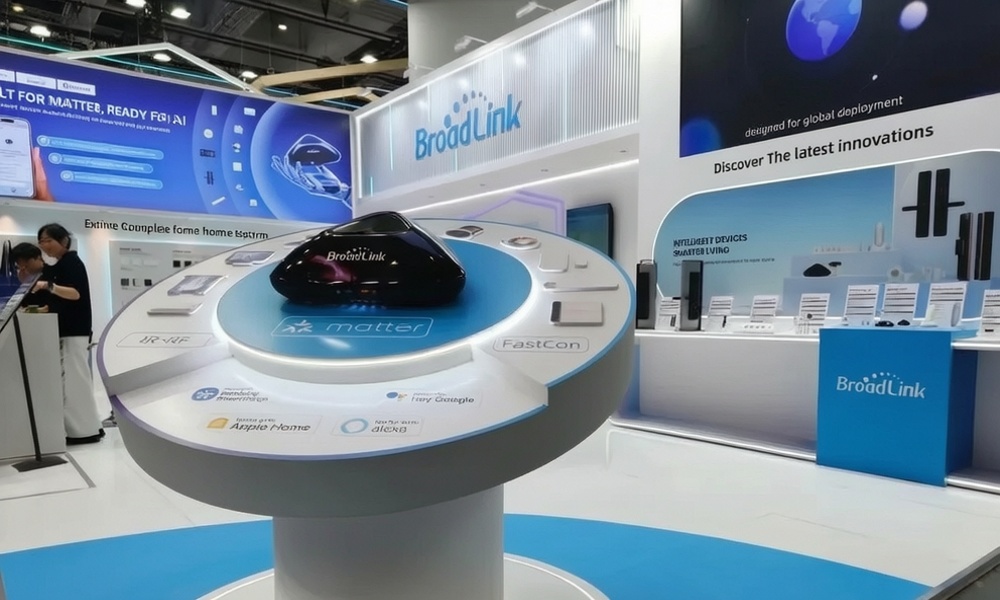
BroadLink, a leading IoT service provider, showcased its HuanSi AI Hub at IFA—an AI approach especially suited for mid- and small-sized appliance manufacturers.
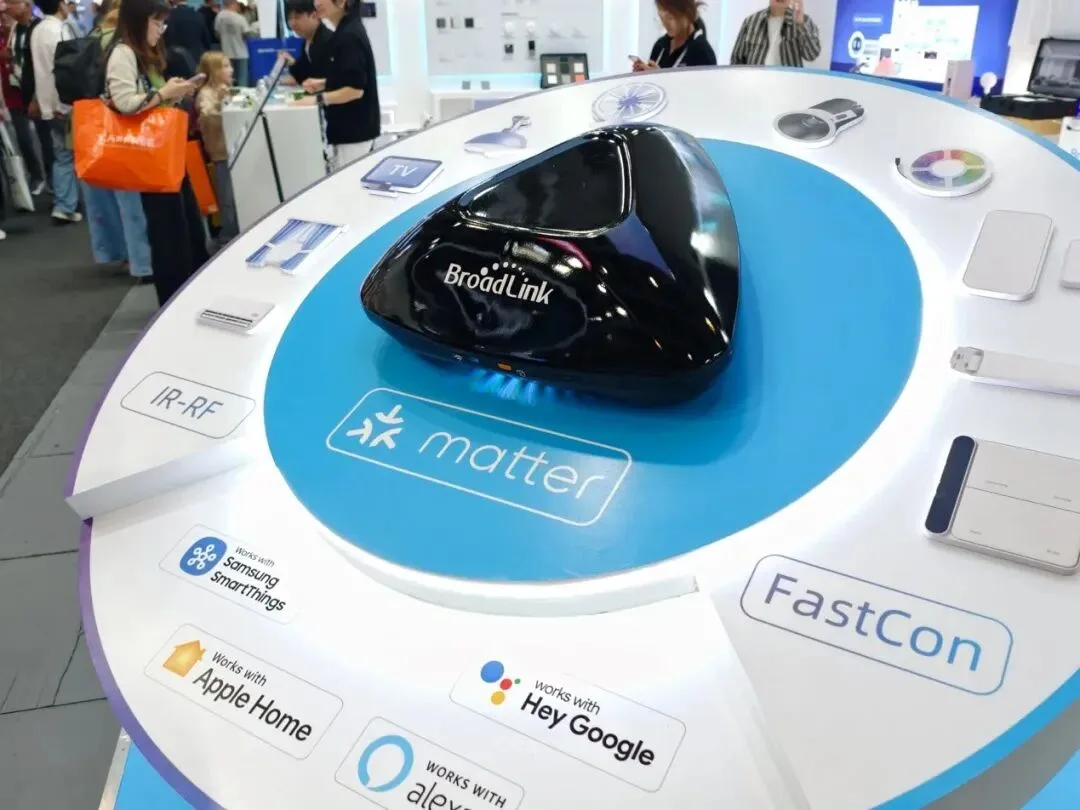 (Image Credit: LeiTech IFA Reporting Team On-Site)
Like conventional smart home systems, the HuanSi AI Hub interacts with users through an AI assistant app. Yet unlike generic large-model-based AI hubs, HuanSi is built upon a purpose-built industry-specific model. This “domain-specific model” approach grants HuanSi several distinctive capabilities difficult for general-purpose alternatives to replicate:
First, BroadLink’s HuanSi AI demonstrates significantly faster responsiveness than generic large models. Despite limited network conditions at the IFA exhibition venue, the BroadLink Magic Home app’s AI assistant consistently completed the full “comprehend–decide–respond” cycle in just one or two seconds.
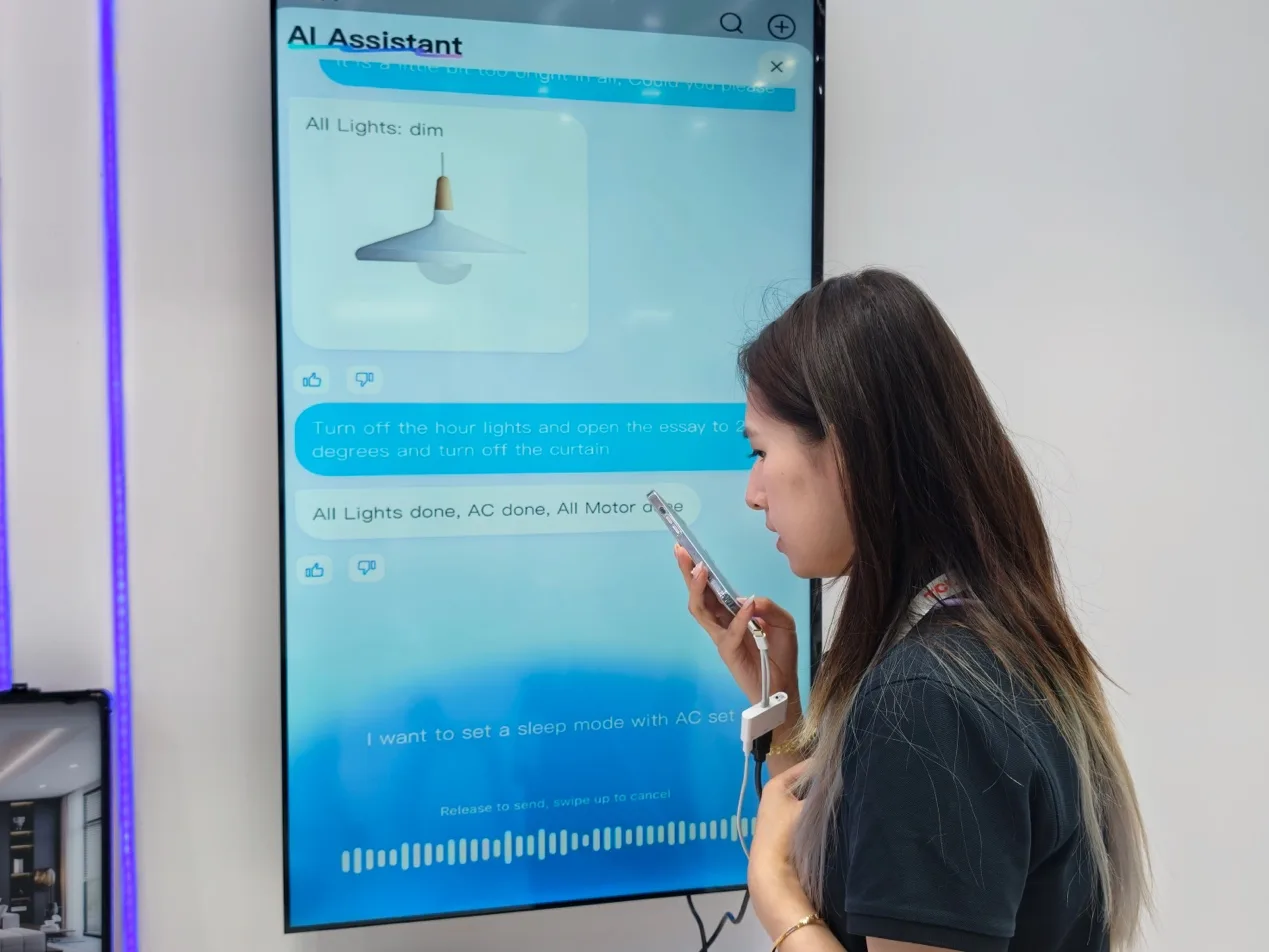
(Image Credit: LeiTech IFA Reporting Team On-Site)
For example, saying “I feel a bit cold inside the room” to the AI assistant triggers the air conditioner to switch to heating mode and set temperature to 22°C—all within just over one second.
You may have also noticed: when issuing commands to the AI assistant, you don’t need to specify exact appliance instructions. Leveraging the industry-tuned large model’s fuzzy-intelligence capabilities, the HuanSi AI Hub automatically infers and decomposes your spoken request—and dispatches appropriate actions across multiple appliances.
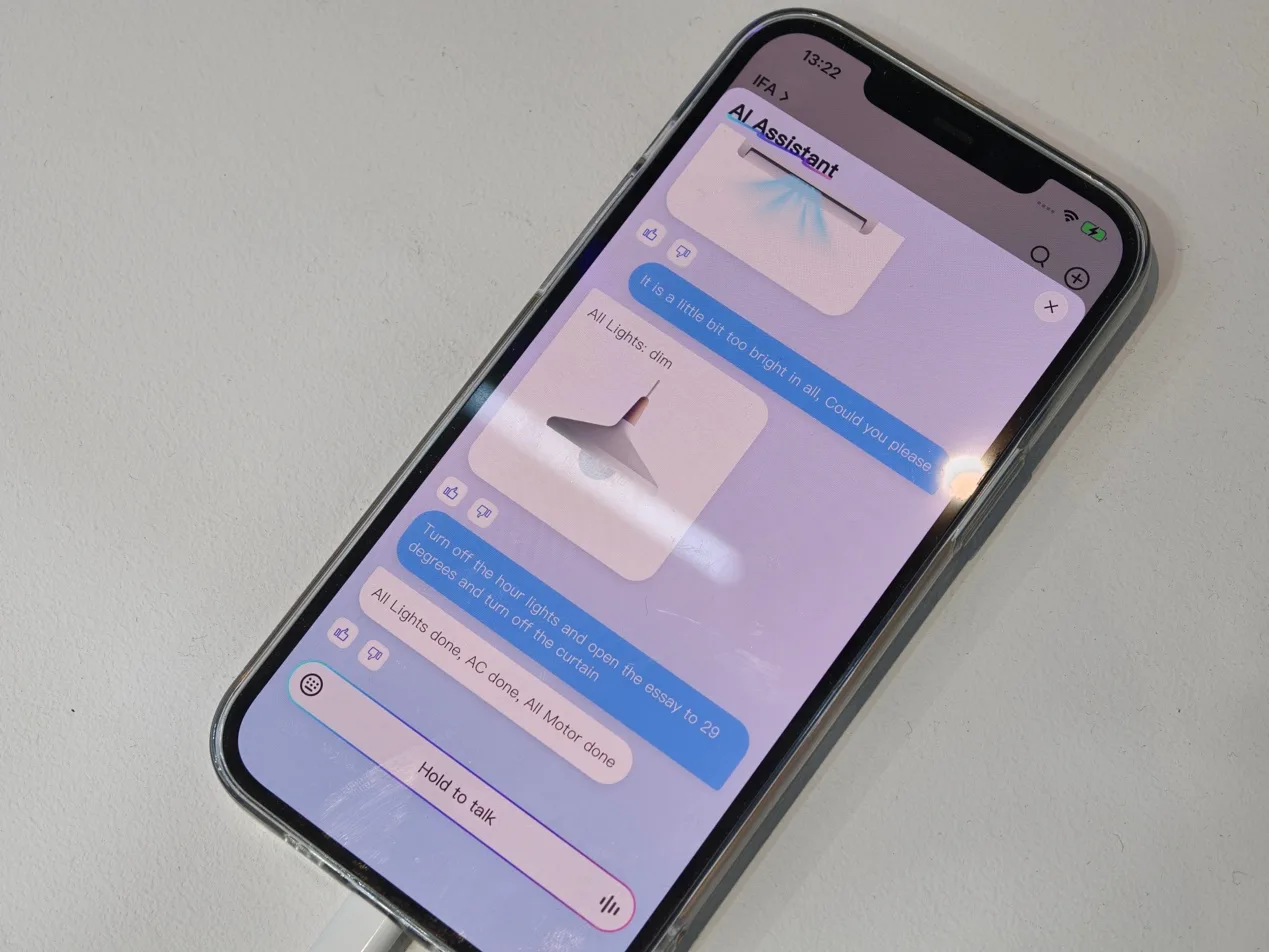
(Image Credit: LeiTech IFA Reporting Team On-Site)
For instance, saying “It’s too bright outside the window” prompts the HuanSi AI Hub to infer your intent isn’t dimming indoor lights—but rather closing the blinds.
More importantly, you can issue vague instructions to the AI assistant—or ask the HuanSi AI Hub to create scene modes combining multiple commands.
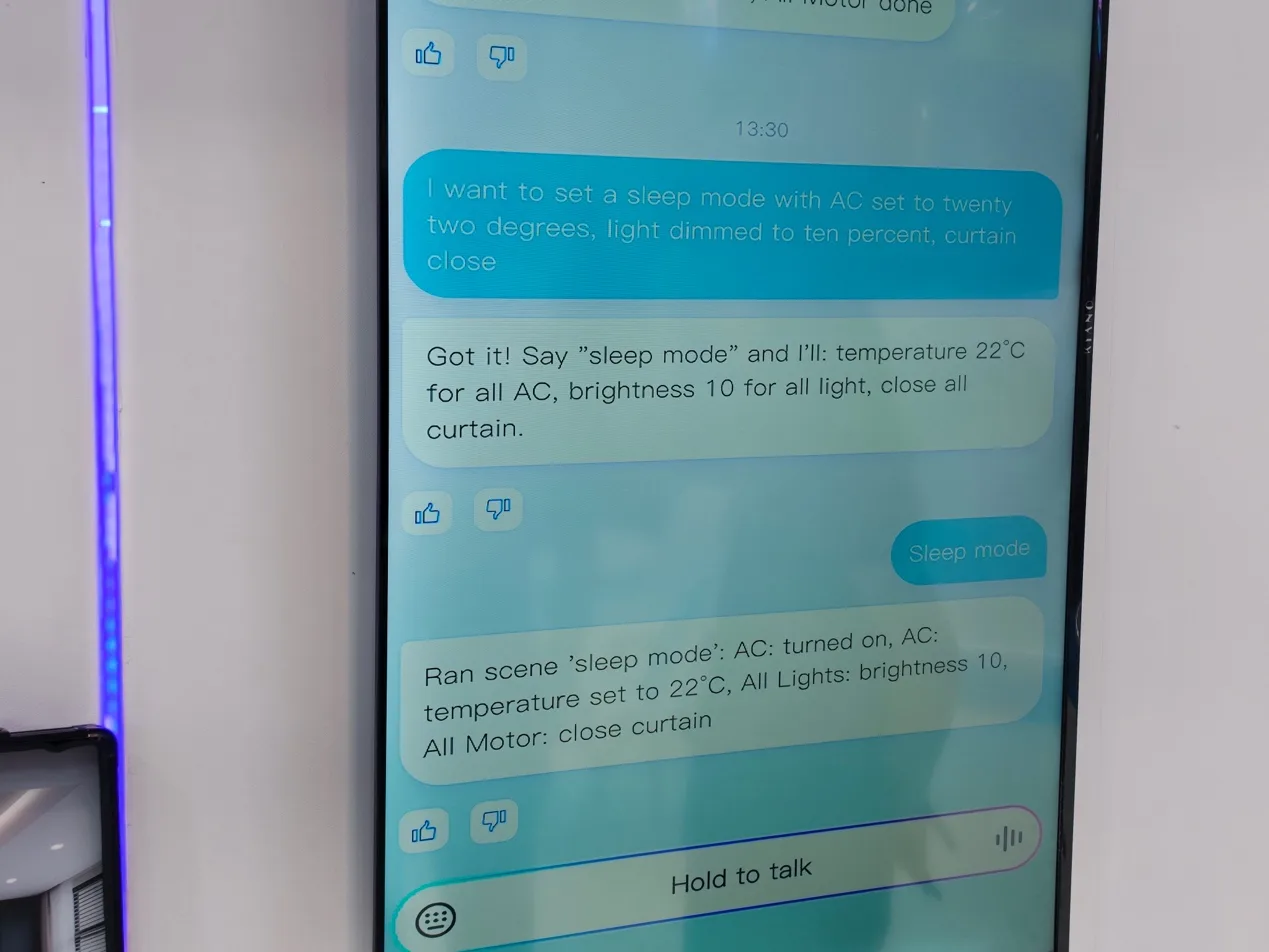
(Image Credit: LeiTech IFA Reporting Team On-Site)
Anyone familiar with smart home setups knows how cumbersome creating intelligent scenes can be: select devices, configure each device’s state, and define trigger rules. With the HuanSi AI assistant, a single spoken instruction suffices—it handles everything automatically. You just speak.
The HuanSi AI Hub’s emphasis isn’t on building another high-compute box—but on positioning AI as a “translator” bridging users and diverse appliances.
A more pragmatic reality: AI may understand humans, but not all home devices natively understand AI. BroadLink also showcased its RM MAX Super Bridge—enabling legacy infrared and RF-controlled appliances to join the Matter ecosystem. This layer may be indispensable for any practical home AI hub:
New devices can integrate natively—but a truly functional “brain” for the home must also make older, non-replaceable air conditioners, TVs, and motorized blinds responsive.
Ultimately, Agent evolution is reshaping foundational rules. Previously, competition centered on connectivity ecosystems—but Matter has made device interoperability increasingly effortless. Going forward, the most valuable position lies in mastering user intent, household context, and ultimate device orchestration authority.
Households still require a logical central AI brain—but it may reside in the cloud, be distributed across appliances and edge nodes, or partially offloaded to on-premises servers. Users needn’t know—or care—where it physically resides.
Certainly, many cross-device Agents showcased at this year’s IFA remain in demonstration-only stages. Real-world experience will reveal actual usability—once manufacturers clarify device-control boundaries, third-party ecosystem openness, local-versus-cloud workload distribution, and accountability for AI misjudgments.
Midea / Hisense / Haier / Samsung: Empowering Every Appliance with Its Own Brain
If UGREEN and Anker are diligently engineering a singular “home brain,” the question has already shifted for giants like Midea, Hisense, Haier, Samsung, and LG.
These appliance leaders already own refrigerators, air conditioners, washing machines, TVs, kitchen appliances—and sensor networks and service infrastructures spanning entire homes. They have little incentive to persuade users to buy yet another box solely to serve as a home hub.
A more natural approach is to disperse the “brain” throughout the home.
The most prominent trend at IFA 2026 is direct AI distribution across individual devices: refrigerators interpreting food inventory; air conditioners sensing ambient temperature and human physiological states; washing machines analyzing fabrics; TVs serving as visual and interactive interfaces; and energy-management systems monitoring electricity pricing and consumption patterns. Devices continue excelling at their core functions—while upper-layer AI orchestrates these capabilities holistically.
Samsung, for example, embedded AI Home into refrigerator, washing machine, and oven displays. Users needn’t walk to a dedicated central control panel—checking other devices’ status while standing before the fridge—or controlling the entire SmartThings ecosystem while beside the washer.
TVs likewise serve as primary interfaces.
Samsung continues strengthening its Vision AI Companion, extending the large-screen TV beyond content delivery into a full-fledged home interaction interface. Consequently, SmartThings—the true “central hub”—increasingly operates as a background platform, with actual access points dispersed across every screen and device in the home.
This reflects a pragmatic insight. After years of smart home adoption, dedicated central control panels have never become mainstream necessities—because few users willingly take extra steps just to turn off lights or adjust AC settings.
If control interfaces already exist on refrigerators, TVs, smartphones, or voice assistants, the rationale for standalone control panels weakens accordingly.
Yet this isn’t enough. With dozens of devices in a typical home, equipping each with AI would merely yield dozens of isolated “smart devices.” The real challenge lies in coordinating them to accomplish shared objectives.
Thus, a more critical evolution is: Agents collaborating as teams.
Midea’s SMART MASTER—highlighted at IFA—doesn’t treat AI as simply adding chatbots to each appliance. Instead, it defines distinct vertical Agents: Comfort, Health, Efficiency, and Service.
The Comfort Agent manages environmental and lifestyle scenarios involving air conditioners, humidifiers, and washing machines. The Health Agent links food inventory in refrigerators, dietary recommendations, and kitchen appliances. The Efficiency Agent oversees household energy usage. The Service Agent handles diagnostics and after-sales support.
Atop this sits a unified entry point. When users issue a command, the system first interprets the intent—then delegates tasks to relevant Agents and devices. In theory, this could coordinate air conditioners, air-purification systems, refrigerators, kitchen appliances, and even robotic vacuums—without requiring users to know how many Agents or devices were involved.
This is where AI Agents deliver genuine value to smart homes.
No longer reliant on preconfigured automation rules painstakingly crafted by manufacturers or users, the system responds directly to user goals—leaving task decomposition and device orchestration entirely to the Agents.
Hisense’s V AIOS, unveiled this year, follows a parallel trajectory. It frames home AI as a four-step process: Sense → Think → Communicate → Execute: first perceiving household status, then comprehending and judging, followed by communicating with users, and finally invoking devices to act.
In concrete scenarios: refrigerators track available ingredients; ovens handle cooking; wine cabinets recommend pairings; washing machines assess fabric types; air conditioners adapt environments based on human positioning; and energy systems optimize electricity usage according to weather forecasts, tariff schedules, and battery storage levels.
In essence, manufacturers are enabling devices to share “context”—so the system knows “who’s currently home,” “what the user plans to do,” and “the real-time status of each device”—before making coordinated decisions.
Only then does an AI-powered home truly cohere.
By contrast, Haier adopts a comparatively measured approach. Overseas, it continues leveraging hOn as its unified smart home platform—connecting refrigerators, washers, kitchen appliances, and air conditioners—enhanced by AI learning of user habits and device behaviors.
Yet Haier’s direction aligns: transforming AI from a feature of individual appliances into a capability woven across the entire appliance ecosystem. Whether users issue commands via smartphone, TV, refrigerator, wall-mounted display, or robot ultimately matters less.
Final Thoughts
While approaches to building home AI hubs vary widely, touring IFA 2026 reveals that the “home AI brain” concept has grown markedly more concrete—and is beginning to materialize in real-world deployments.
Especially compared to earlier smart home systems demanding manual rule configuration and scene scripting, this year’s offerings genuinely attempt to understand *what users want to achieve*—then autonomously coordinate devices to fulfill those goals.
This may represent the ideal way for AI to enter homes. Users don’t care how many Agents exist, where models run, or whether their refrigerator gained AI capabilities—nor do they change daily habits because of it. What ultimately endures are experiences that require no learning, no tinkering, and no conscious awareness of AI itself.
This year’s IFA “home AI brains” haven’t yet reached that ideal—but the direction is clearer than ever before.
From September 4–8, the world’s largest home appliance and consumer electronics exhibition—IFA 2026—is being held in Berlin.
As the “premier new media outlet for IFA coverage”—globally recognized for its authoritative AI-focused reporting—LeiTech has dispatched its largest and highest-caliber reporting team to Berlin this year. Employing a “2+N” model (two live hosts + multiple on-site editors + multiple backend editors), LeiTech delivers real-time, multi-dimensional, and first-hand IFA 2026 coverage—with special focus on AI Agents integrated with appliances and hardware, robotics technologies applied to home scenarios, emerging trends in human-car-home digital lifestyles, and Chinese brands’ global presence.
The LeiTech IFA 2026 Reporting Team is actively covering the event in Berlin—stay tuned!