 雷科技
雷科技

























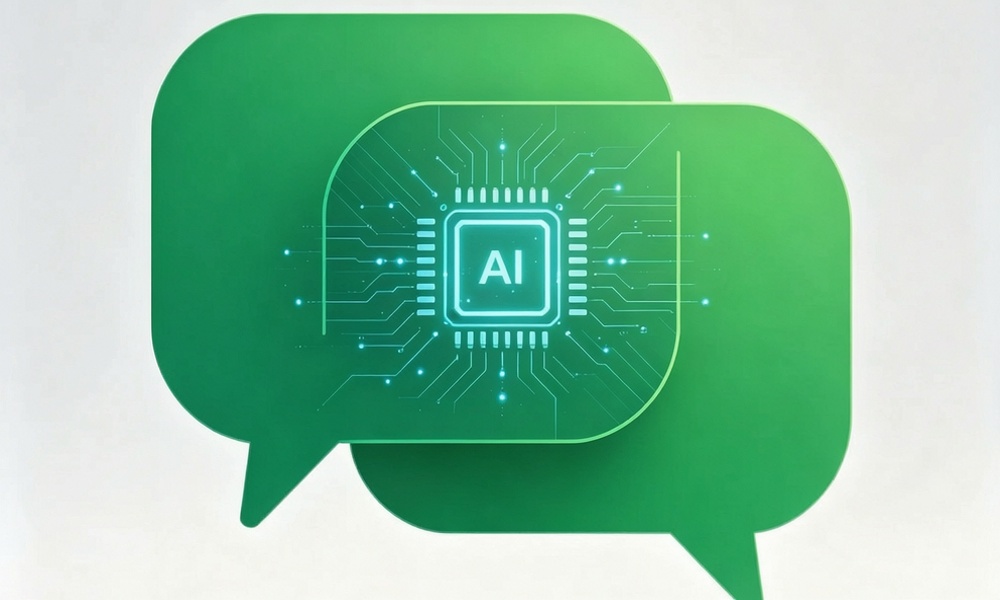

News on August 13: Tencent confirmed in its latest financial report that Xiaowei, WeChat’s built-in AI agent, has launched small-scale prototype testing.
Unlike previous AI tools, it features an independent homepage entry and deep integration with various WeChat functions and Mini Program services. WeChat is set to welcome a permanent AI assistant.
Rumors of this feature surfaced earlier. Many netizens shared screenshots of the internal beta back in June this year.
Xiaolei BIBI (ID: xiaoleibbb) will take an in-depth look at this new feature below.
Based on the current test version, the entry is located at the top left corner of WeChat’s main interface as an icon resembling two small eyes. Users can tap it to enter the chat interface directly.
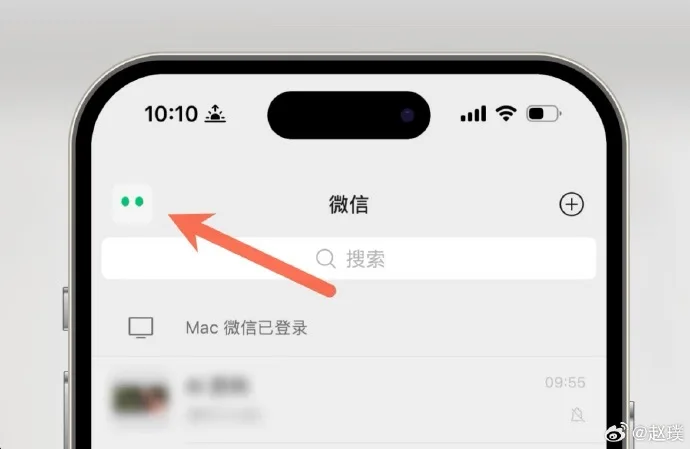
Image source: Weibo
It is powered by Tencent’s self-developed WeLM large language model with a clear positioning: it is not merely a casual chatbot, but an ecosystem-orchestrating agent.
Simply put, Xiaowei is built to get things done. Frequent daily tasks within WeChat can be completed with a single sentence.
It can summarize hundreds of group-chat messages with one click, generate social-media captions instantly, create calendar events, or contact friends—all via voice command or a few keystrokes.
Its biggest highlight lies in the ability to invoke Mini Programs.
Users no longer need repeated searches and redirects for hospital appointments, ticket bookings and food delivery — all can be handled through one simple command.
Furthermore, the entry is not limited to the homepage; access points are embedded across nearly all core WeChat scenarios.
A shortcut button is available in the chat input box, and Xiaowei can also be summoned while reading Official Account articles or browsing Channels.
As for the widely concerned security issues, Tencent has implemented risk control with strict permission restrictions.
The AI cannot independently carry out critical operations including message sending, payments and transfers. Every action requires manual user confirmation to take effect.
This is far from WeChat’s first foray into AI. A host of related functions have been rolled out over the past two years.
As early as February 2025, WeChat Search integrated large models supported by the Hunyuan and DeepSeek dual engines.
In April, Tencent Yuanbao launched. Users could add it as a WeChat contact to analyze Official Account articles, interpret documents and identify image content.
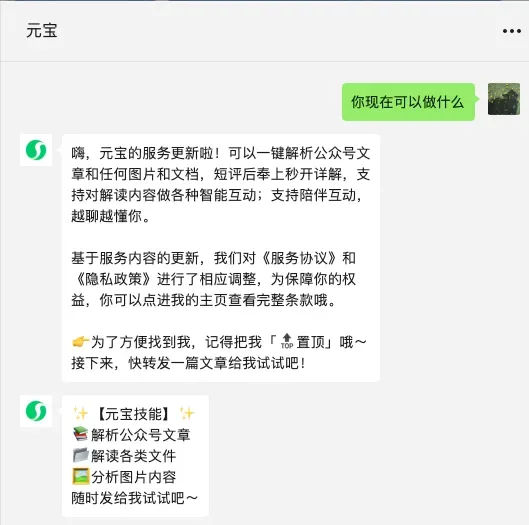
Image source: Weibo
Besides these, there are AI visual recognition via Scan, AI writing assistance and AI comment generation for Moments, and more.
Many netizens point out that WeChat offers plenty of AI features, yet they are scattered across the platform, forcing users to hunt for each entry separately.
The launch of Xiaowei consolidates all these capabilities within a single agent that operates across all WeChat scenarios, forming a unified AI command hub at last.
News of the new feature immediately split netizens into two opposing camps.
Many users regard Xiaowei as a boon for lazy people and office workers.
Nevertheless, criticism abounds, with privacy concerns topping the list. Some netizens worry the AI will gain access to their chat histories.
Another point of contention is the fear that AI will dilute the authentic social atmosphere of WeChat.
Numerous users already complained about the previously launched AI writing and AI comment functions for Moments. If people even rely on AI to post updates and write comments, how much genuine sentiment remains in communication?
A former Tencent executive also voiced criticism online, stating that this only turns ordinary users into non-player characters and erodes genuine human interaction.
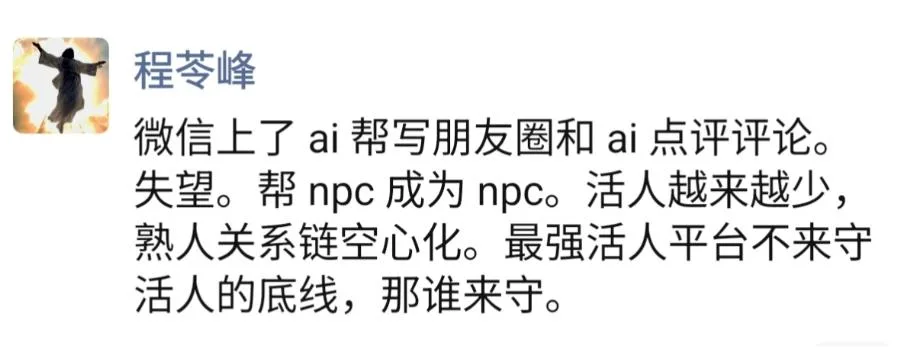
Image source: Weibo
Many users with internal beta access also report that the current version of Xiaowei is not yet highly intelligent.
It sometimes confuses today and tomorrow, has mediocre context retention, and tends to stumble when handling complex operations.
Others worry that a permanent built-in AI will cause higher power consumption and lag on mobile phones. WeChat already consumes substantial memory, and running an additional AI in the background is likely to further degrade battery life and performance.
In the view of Xiaolei BIBI (ID: xiaoleibbb), developing a native AI is an inevitable move for WeChat.
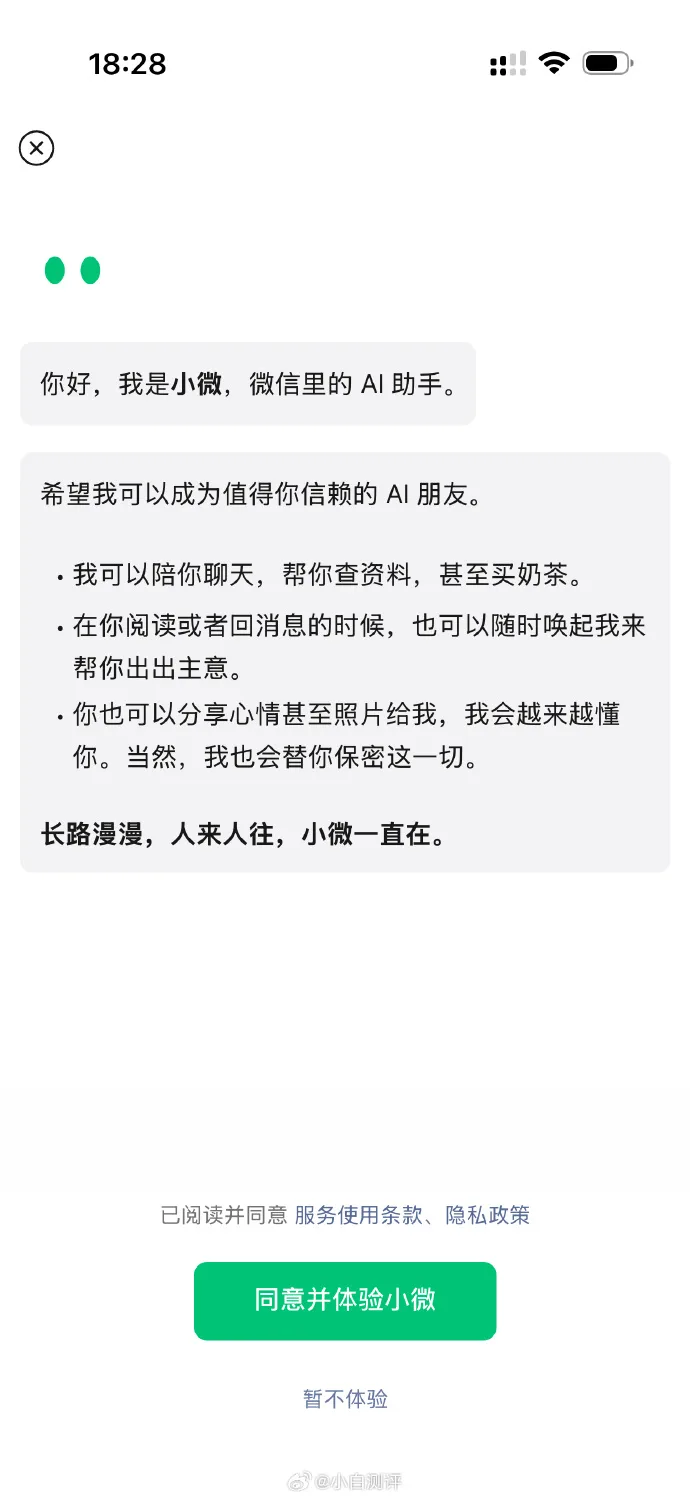
Image source: Weibo
WeChat boasts inherent advantages. After all, it has a massive user base, alongside China’s most sophisticated ecosystem encompassing Mini Programs, payments and social interactions.
If its AI is well-developed, it can be directly integrated into the daily lives of over a billion people.
Nevertheless, its ultimate success hinges on how well Tencent strikes the right balance.
It must not compromise user privacy for more features, nor allow AI to overstep into social interactions.
Judging from the current framework, Tencent has adopted a restrained approach.
As for whether the user experience can be improved and whether the tool can truly address users’ pain points, we will have to wait and see after its official launch.
One final question: Are you looking forward to WeChat’s native AI assistant? Feel free to share your thoughts.
The world’s most important robotics industry barometer—the World Robot Conference (WRC) 2026—is set to make a major debut, followed closely by the World Humanoid Robot Games.
Over 300 leading exhibitors—including Unitree, Zhiyuan Robotics, Qiyuan Robotics, Magic Atom, Galaxy General Robotics, Cloud Deep Robotics, and Lingxin Qiaoshou—will jointly define the future of global robotics.
WRC will answer all core questions about robotics.
LeiTech’s WRC 2026 reporting team lands in Beijing for comprehensive, on-the-ground coverage.