 雷科技
雷科技














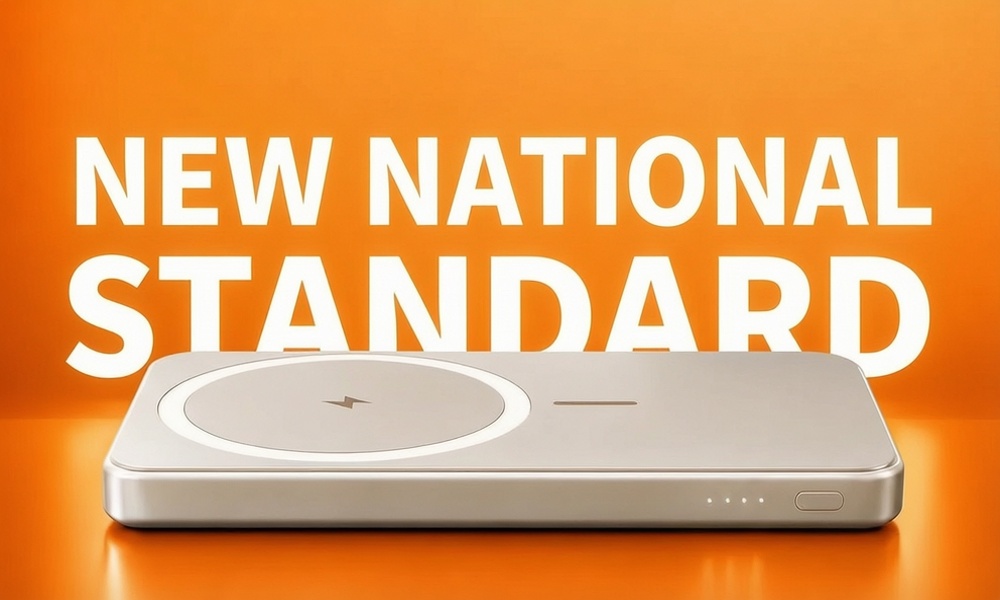
Just yesterday (August 10), Xiaomi launched a 20,000mAh built-in-cable power bank certified under the 2026 new national standard. It comes in two variants supporting 45W and 67W charging. What has surprised many consumers, however, is its pricing: 499 yuan and 599 yuan respectively.
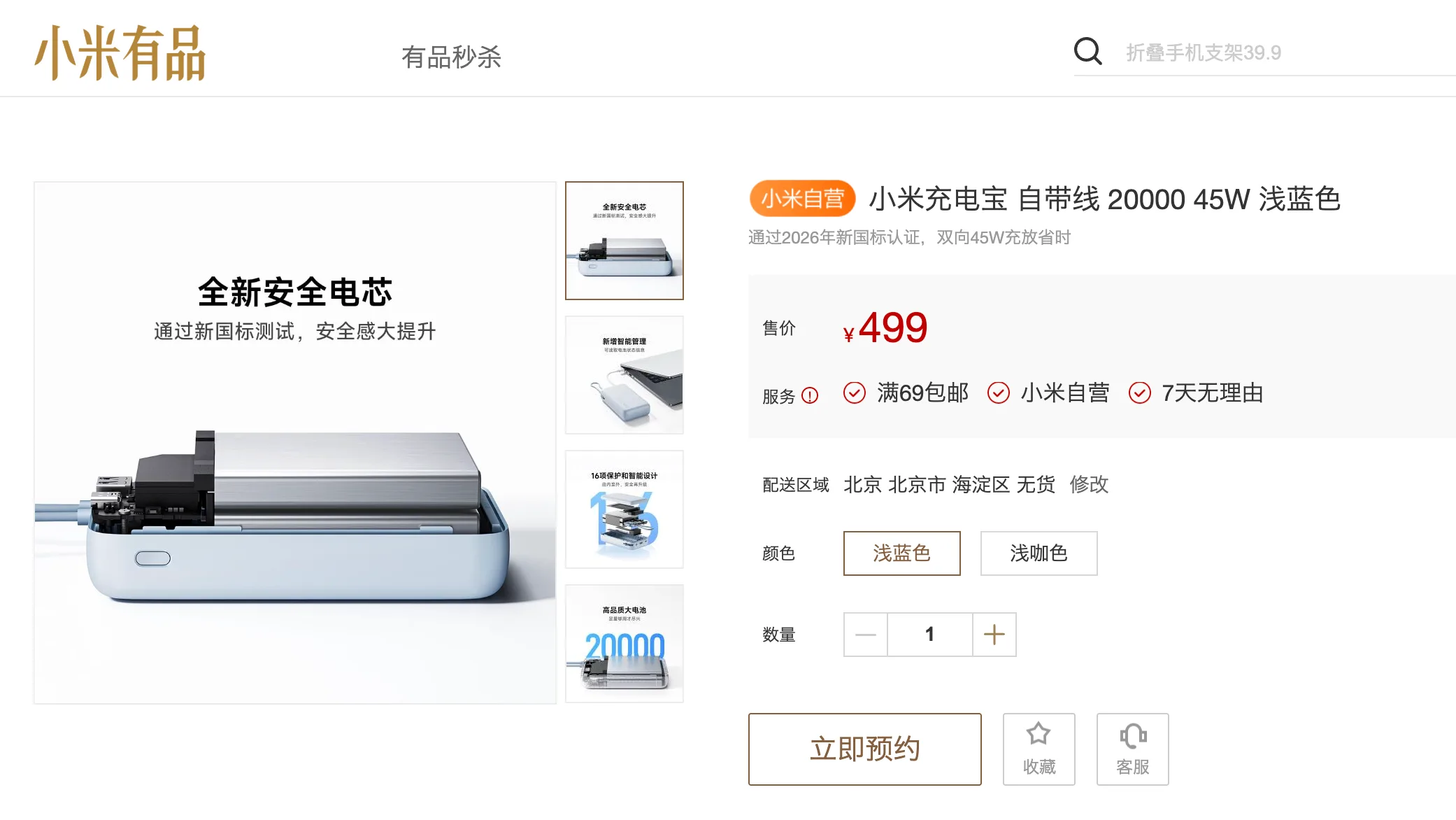
Image source: Xiaomi
Labeled with the "2026 New National Standard", power banks have suddenly reached price levels comparable to mid-range earbuds, sparking plenty of online complaints: Are all power banks compliant with the new national standard this expensive?
There is a massive mismatch between specifications and price. Is this still the brand known as the price slayer in the consumer electronics space? Before jumping to conclusions, however, the official pricing for Xiaomi’s new national standard power bank is not finalized. The product is still open for pre-orders, and the listed prices of 499 yuan and 599 yuan may be placeholder prices to prevent accidental purchases.
For reference, at the Zunjie Times flagship MPV and Huawei All-Scenario New Product Launch held on August 5, Huawei unveiled the P0023, one of the first all-in-one smart power banks with built-in cables certified under the 2026 New National Standard. Boasting a 12,000mAh capacity and 100W bidirectional charging, it retails at 399 yuan.
Its price remains unchanged from the previous generation P0023, which features identical specifications: 12,000mAh and 100W bidirectional charging.
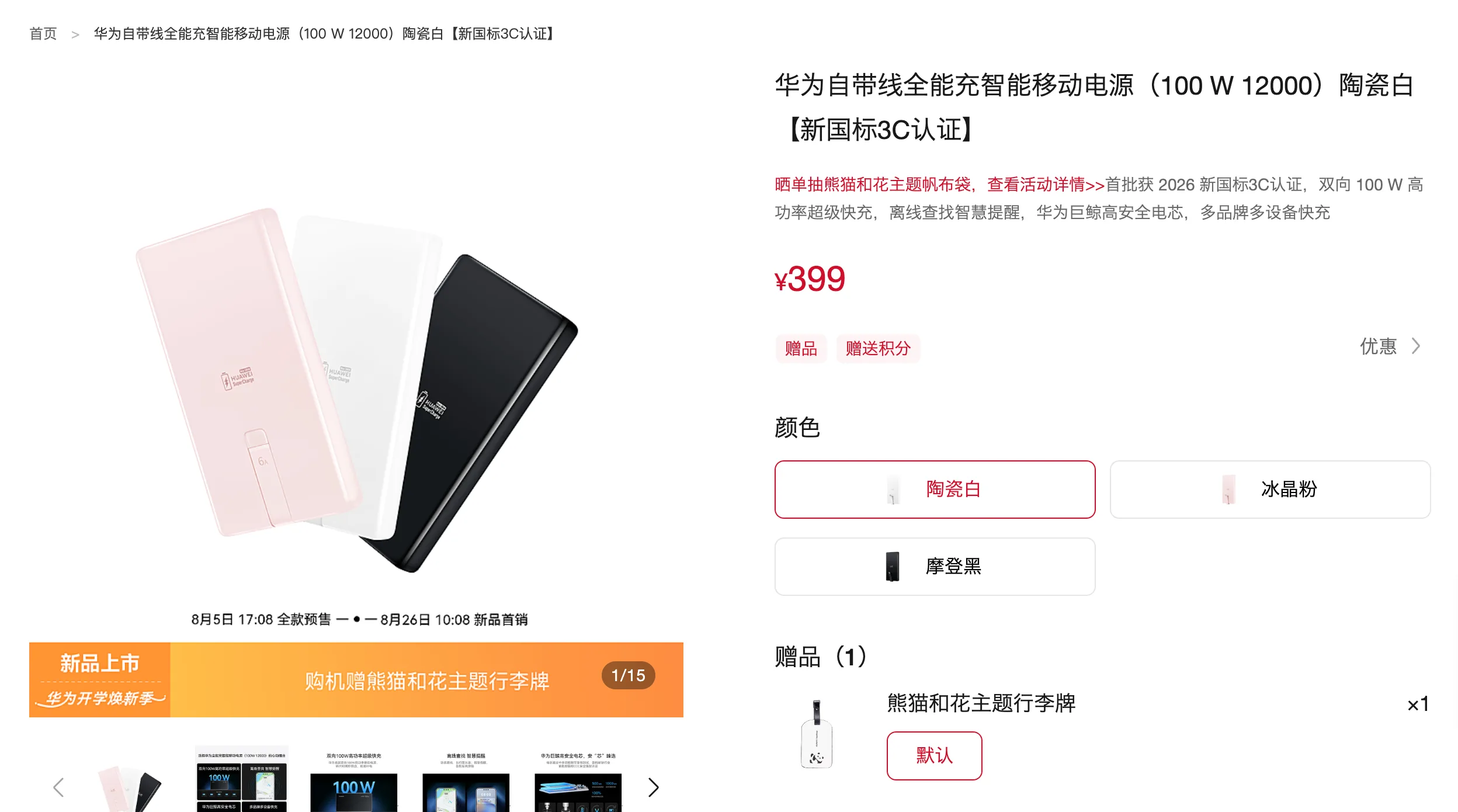
Image source: Huawei
Therefore, we can boldly infer that 499 yuan and 599 yuan will not be the final prices of Xiaomi’s new power bank. Nevertheless, concerns that the new national standard may drive up product prices are legitimate. More importantly, as products complying with the new standard are gradually hitting the market amid the transition from the old standard to the new one, consumers need to sort out several key points.
(LeiTech Note: At the REDMI K100 Series new product launch held on the evening of August 11, Xiaomi officially announced that the pricing for its first new national standard power bank is 229 yuan and 269 yuan.)
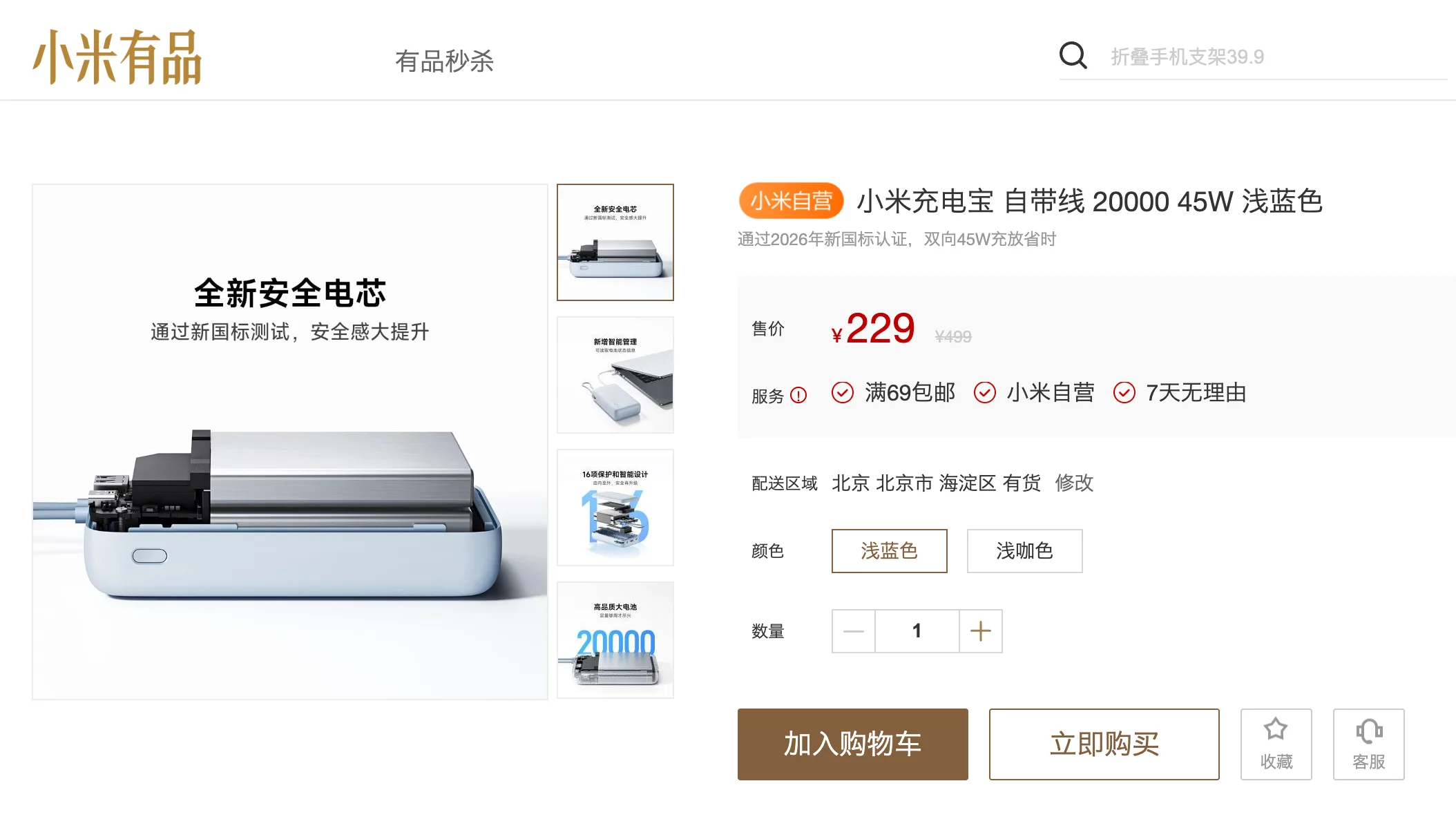
Image source: Xiaomi
But the core question is: in 2026, how should ordinary consumers like us make a choice?
Do power banks really require a dedicated new national standard?
Safety standards for power banks did not first emerge in 2026.
Starting from August 1, 2024, power banks have fallen under the scope of 3C certification. Only products that comply with GB 4943.1—2022 (governing overall equipment safety) and GB 31241—2022 (governing battery safety), obtain certification and bear the 3C mark can leave factories and be sold.
The catch is that these two are broad general standards. As a specific product category, power banks undergo repeated charging and discharging. They are often carried in backpacks and suitcases, exposed to drops, extrusion and high temperatures, and brought onto planes, high-speed trains, hotels and other crowded venues. Their real-world challenges and safety risks far exceed the design scope covered by general standards.
In essence, general standards merely set a minimum threshold. They can hardly account for battery cell ageing, material substitution within supply chains, anomaly logging and long-term traceability.
This issue was brought sharply into focus by a string of incidents last year. Brands including Romoss and Anker carried out large-scale product recalls over battery cell hazards, and the 3C certificates for multiple products were suspended or revoked. Effective June 28, 2025, the Civil Aviation Administration of China also banned power banks without a clear 3C mark, those with indistinct markings, and units belonging to recalled models or batches from being carried on domestic flights.
According to statistics compiled by People’s Daily, the State Administration for Market Regulation ordered enterprises to recall defective power banks totalling:
1.3977 million units in 2025.
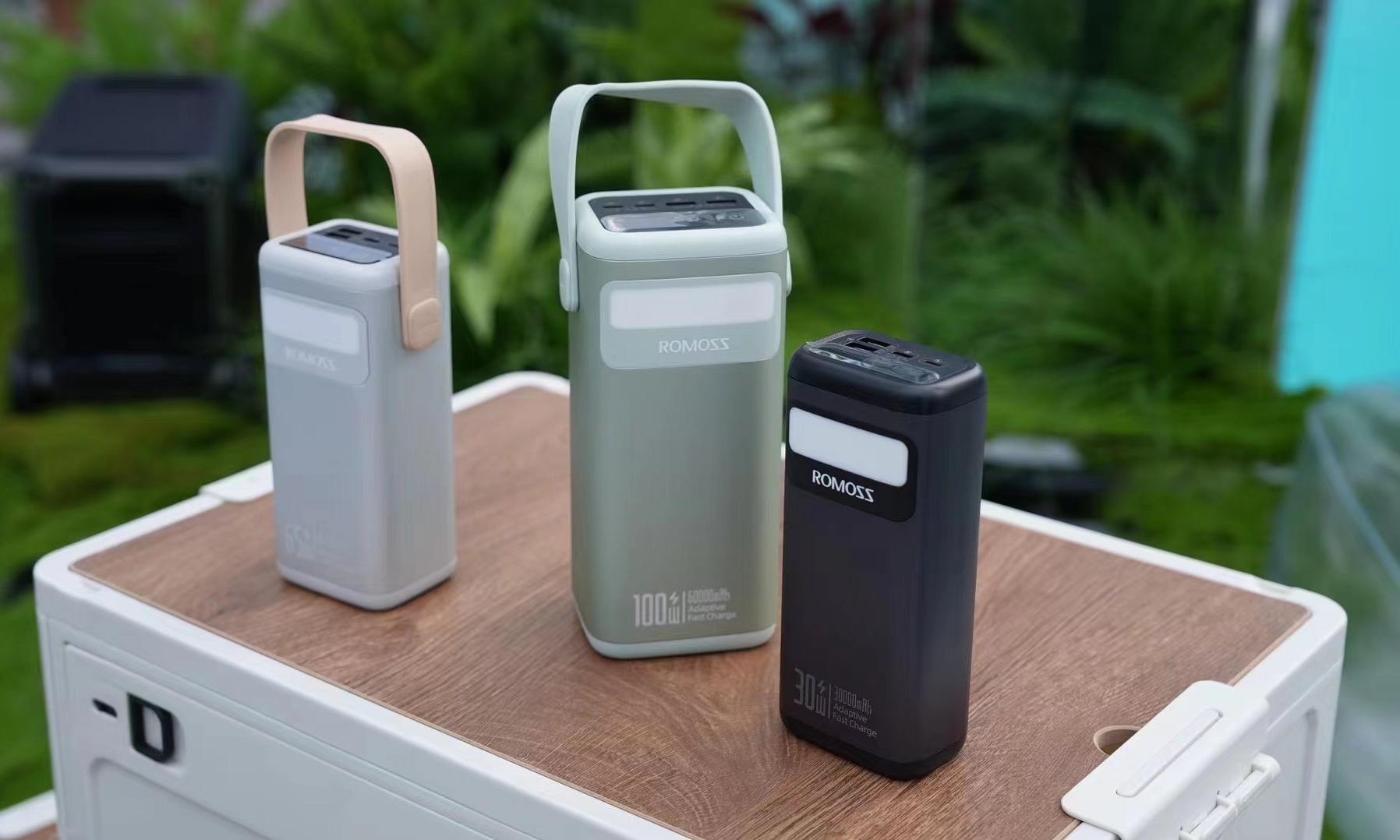
Romoss, image source: LeiTech
This forms the backdrop for the release of GB 47372—2026 Safety Specification for Power Banks (the 2026 New National Standard). Published on March 31 this year, it will enter into mandatory enforcement on April 1, 2027, and is China’s first mandatory national standard specifically formulated for power banks.
When it comes to the new standard, the most widely discussed requirement is probably “no fire or explosion upon needle penetration”, yet the actual criteria it lays down extend far beyond that.
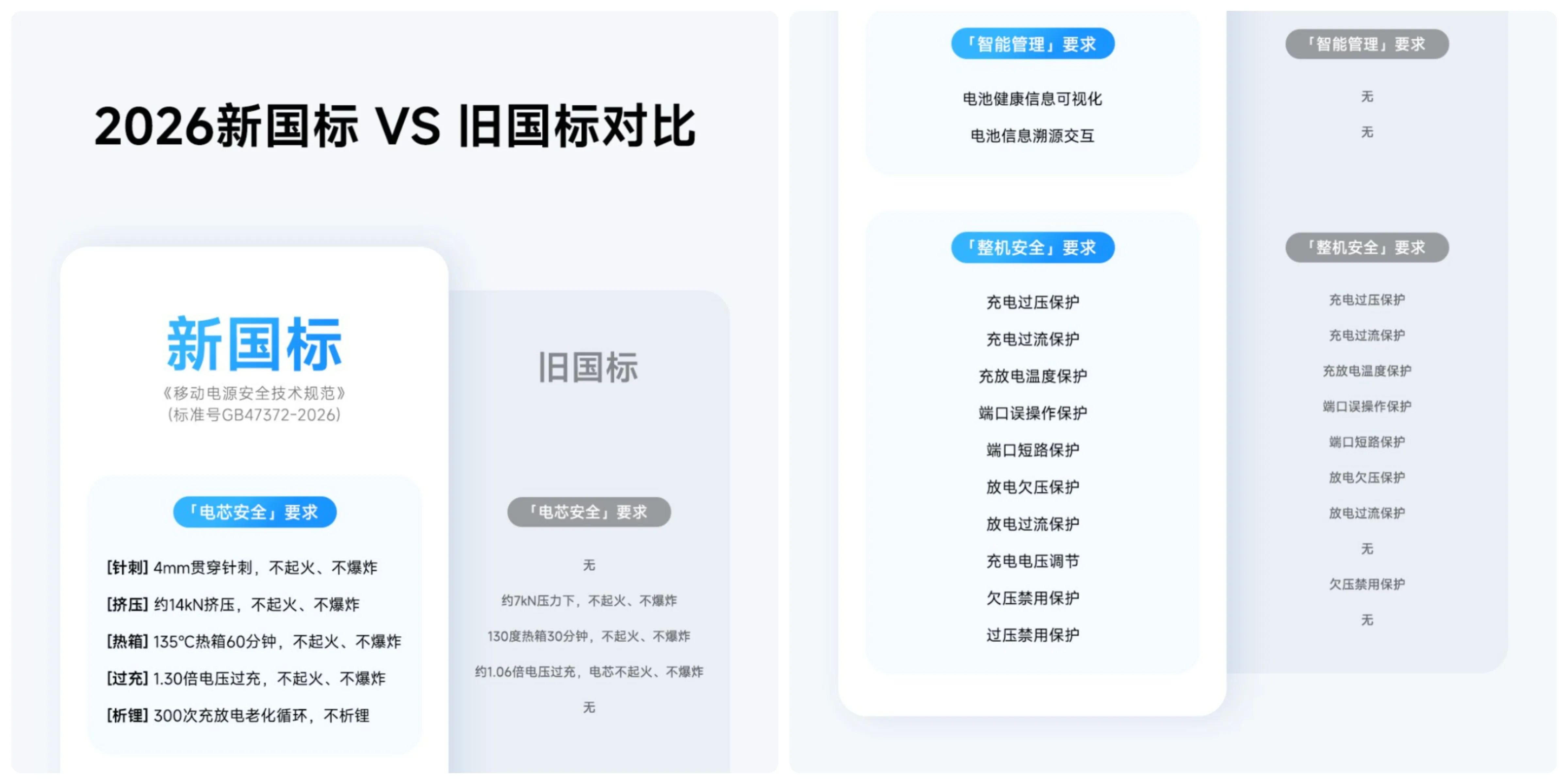
Image source: Xiaomi
On the one hand, targeting internal short circuits potentially caused by extrusion and manufacturing impurities, the new standard tightens extrusion test conditions, introduces the nail penetration test, and further stiffens thermal abuse tests. To address risks where precipitated metallic lithium after prolonged use may pierce the separator, it also adds a lithium plating inspection following 300 charge-discharge cycles.
Overcharge protection has been upgraded from single-layer to dual-layer protection, with the test voltage raised to 1.3 times the charging cut-off voltage. In the event of severe overvoltage, the power bank must enter a locked state to prevent a faulty battery from continuing to operate. It should also lock up automatically if cell voltage drops excessively due to long-term idle storage or internal micro-short circuits.
Furthermore, the new national standard mandates markings on the casing for rated energy, recommended safe service life and a unique identification code. Requirements are also extended further upstream, incorporating incoming raw material inspections, oversight of key production stages and product consistency control.
A more tangible change lies in the mandatory requirement for intelligent Battery Management System (BMS) safety control with visualised data. The standard requires power banks to continuously monitor the voltage of each series-connected cell, the total voltage of the battery pack, and temperatures at the most critical positions of cells. Such data must be visualised — either displayed directly on the power bank’s screen or viewable on devices such as mobile phones and computers.
Taking the first new-standard power banks launched by Huawei and Xiaomi as examples, neither model comes with a built-in screen. Huawei users can check power bank status (including battery level and operating conditions) via the Huawei Smart Life App. Meanwhile, Xiaomi’s product page indicates that wired connection to a computer enables real-time monitoring of individual cell data and charging progress.
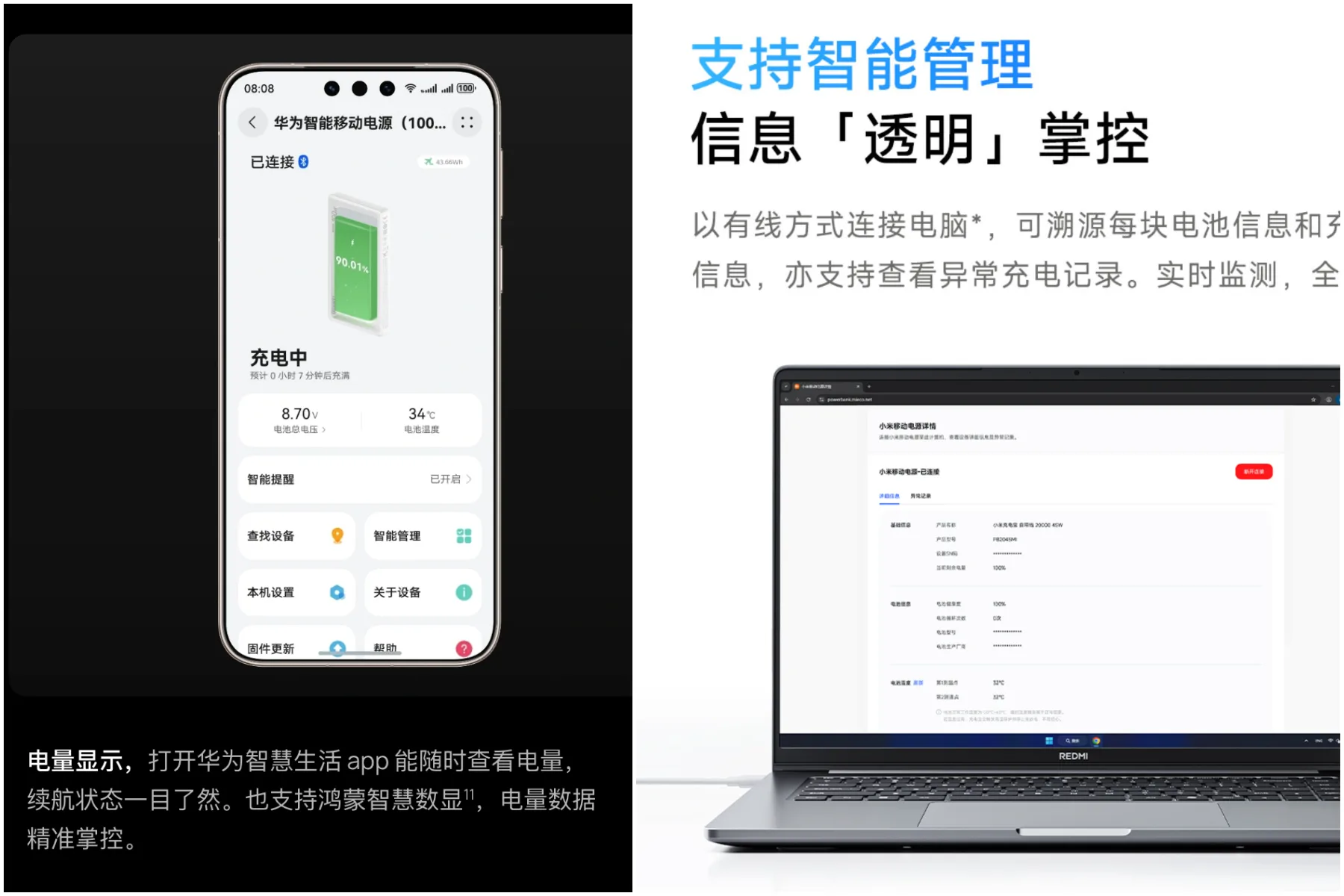
Image source: Huawei, Xiaomi
According to current information, Baseus has obtained certification under the new national standard for its yet-to-be-released 10,000mAh slim magnetic Air power bank (Model E00363), which supports NFC tap-to-check access to data such as power level and battery status.
In short, BMS data must be "visualizable", yet there exists a wide variety of access points and interaction methods for such visualisation.
Important note: Being "designed in compliance" does not equal being "certified".
First of all, the new national standard does not mean existing power banks with old-version 3C certification that consumers are currently using must be discarded.
In line with the transition plan issued by the China Quality Certification Centre, manufacturers may apply for 3C certification under either the old or new standard rules before March 31, 2027. Starting April 1, 2027, power banks must hold 3C certificates issued in accordance with the new rules and new standard before they can leave factories, be sold or imported. Power banks carrying older 3C certification remain usable and may still be carried on board aircraft.
Turning to the current market landscape, only a small number of products have obtained certification under the 2026 new national standard so far. They nevertheless cover major brands including Huawei, Xiaomi, Baseus, Ugreen, Anker and even Meituan (shared power banks). Curiously, Cuktech, one of the drafters of the new national standard, has yet to secure certification.
At present, however, none of these certified new-standard power banks, including the Huawei and Xiaomi models mentioned above, are available for immediate purchase. Huawei has opened full pre-orders, with official first sales scheduled for August 26. Xiaomi’s model remains in the pre-reservation phase, and its exact launch date has not been announced.
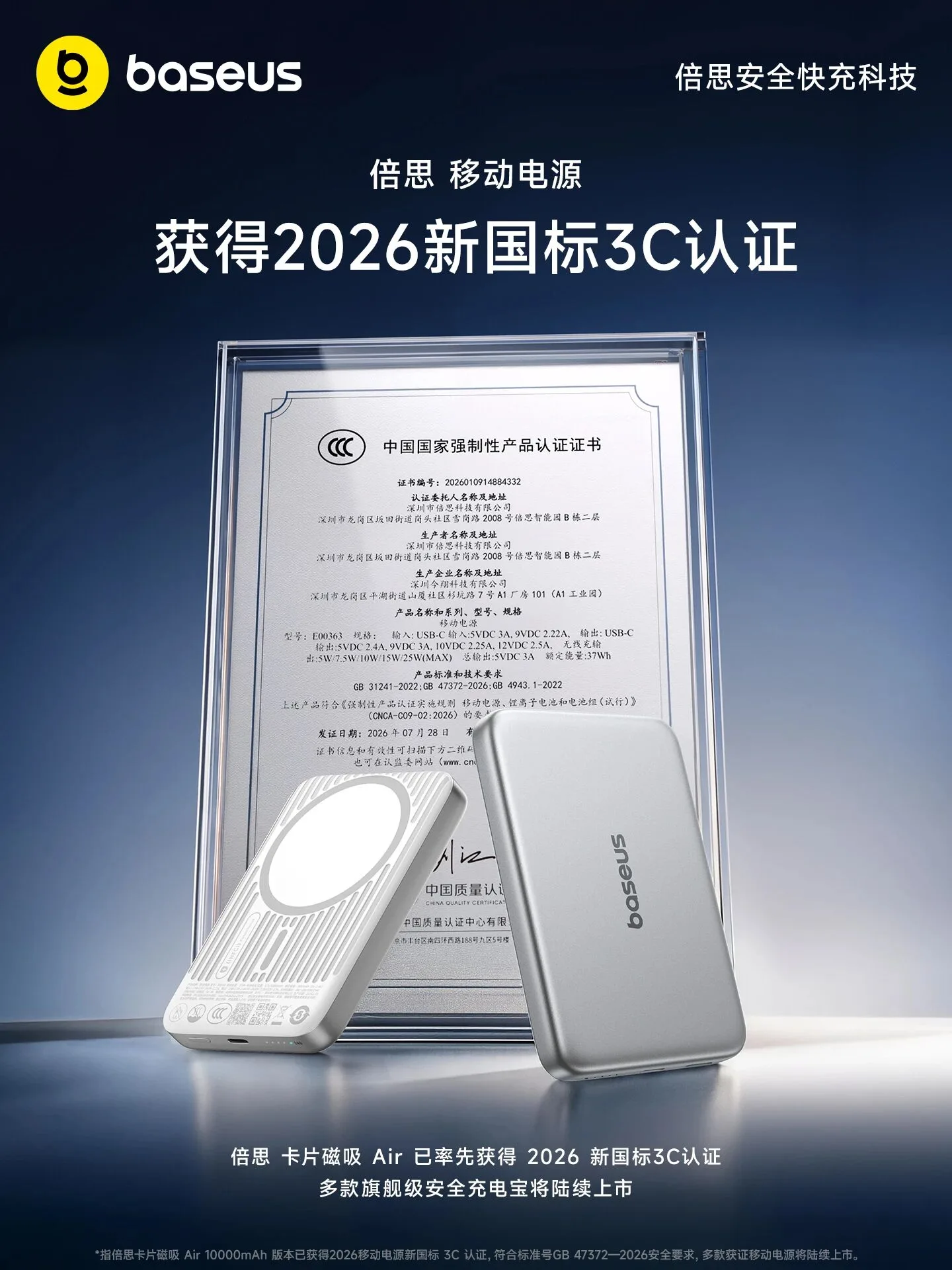
Image source: Baseus
Some so-called "new national standard power banks" you can find on e-commerce platforms are actually only "designed in accordance with the 2026 new national standard". Examples include Xiaomi’s built-in-cable 20000mAh 22.5W power bank that went on sale recently, as well as numerous power banks from mainstream and lesser-known brands advertised as complying with the new national standard.
Brands such as Xiaomi and Ugreen explicitly state they are "designed in accordance with the 2026 new national standard", which is relatively transparent. Many other brands, however, blur the distinction between products "designed in accordance with the 2026 new national standard" and those "certified under the 2026 new national standard".
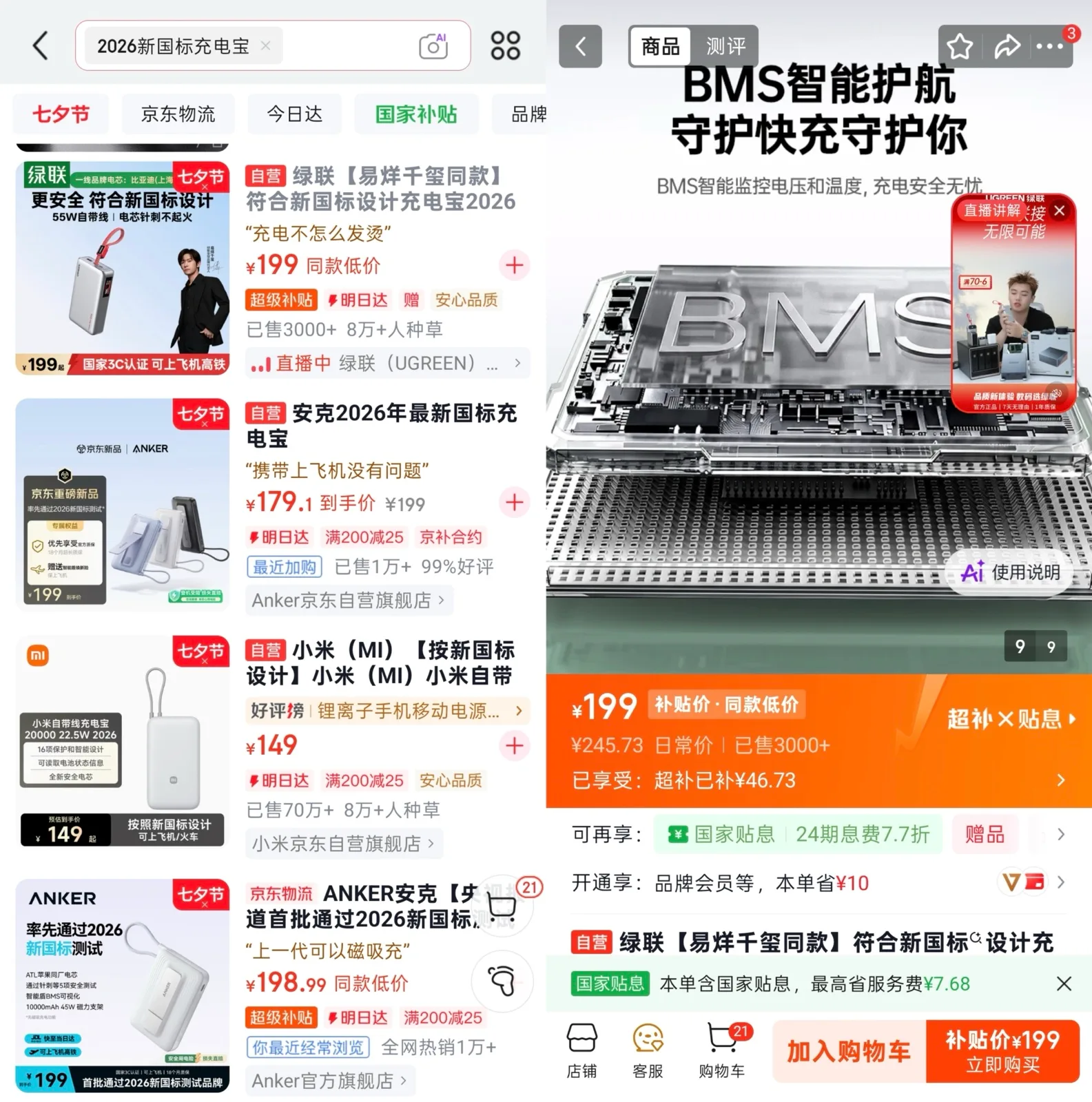
Image source: JD.com
So what exactly does "designed in compliance with the 2026 New National Standard" mean? And how is it different from "certified under the 2026 New National Standard"?
Simply put, products marked "designed in compliance with the 2026 New National Standard" are developed and tested following the requirements of the new standard. Manufacturers may well have adopted nail-puncture-resistant battery cells, integrated intelligent management systems and fault logging, and conducted internal or third-party testing. Nevertheless, a product cannot be regarded as certified under the 2026 New National Standard unless GB 47372—2026 is listed as the certification basis on its 3C certificate.
The reality is that many products only hold 3C certification under the old standards yet market themselves as compliant with the new national standard.
The core difference lies in official validation. Tests conducted by manufacturers or third-party labs lack sufficient credibility, especially after the trust crisis sparked by the Romoss incident last year. For ordinary consumers, official national standard certification serves as the most accessible and impartial form of validation.
The two terms must not be confused.
How should consumers choose a power bank right now?
As mentioned earlier, power banks with valid 3C certification under the old standards remain perfectly usable. There is no need to replace your existing power bank solely for the sake of meeting the new national standard.
That said, if you are planning to purchase a new power bank and your budget allows, I recommend prioritising models certified to GB 47372—2026. The first batch of such certified products will likely go on sale within the next two to three months. More rigorous cell testing, fault recording and traceability features make these models a worthwhile pick for frequent air and high-speed rail travellers, or anyone who regularly keeps a power bank inside a bag for extended periods.
Products "designed in line with the new national standard" are also an option, provided they come from reputable brands, hold genuine and valid 3C certificates under the old standards, clearly specify on product listings which new-standard designs and tests have been implemented, and carry a substantial price advantage over fully certified models. If the price gap is only a few dozen yuan, upgrading offers little merit.
Above all, avoid paying a premium merely for a manufacturer’s claim of "new national standard design", as such claims cannot substitute full official certification.
Whichever option you select, bear in mind that the 3C mark represents only the minimum factory requirement. Immediately stop using a power bank if it swells, overheats abnormally, emits strange odours, suffers casing cracks, or endures severe drops or compression. Do not continue using recalled models just because they still charge. Avoid charging power banks for long periods near pillows, bedding or inside sealed bags, and never leave them in vehicles exposed to direct sunlight.
To be fair, the 2026 New National Standard will inevitably reshape the industry, and the first wave of compliant new products will mostly target the mid-to-high-end market. We are currently in a transitional phase marked by temporary confusion: certified products remain scarce, brands are packaging safety upgrades as selling points, and e-commerce listing titles muddle multiple related concepts.
For ordinary consumers, there is no urgent need to chase newly launched products.
The world’s most important robotics industry barometer—the World Robot Conference (WRC) 2026—is set for a major debut, followed closely by the World Humanoid Robot Games.
Over 300 top-tier exhibitors—including Unitree, Zhiyuan Robotics, Qiyuan Robotics, Magic Atom, Galaxy General Robotics, CloudDeep, and Lingxin Qiaoshou—will jointly define the future of global robotics.
WRC 2026 will answer every core question about robotics.
LeiTech’s WRC 2026 Reporting Team lands in Beijing for exclusive coverage.