
 雷科技
雷科技


























News update, August 6: Xiaolei Bbb (ID: xiaoleibbb) spotted a trending story today about another netizen who landed in serious trouble after over-relying on AI.

Image source: Screenshot from Weibo
This incident is far more serious than previous ones, and it nearly cost someone their life.
Honestly, using AI to assist with weight loss is pretty common. Xiaolei Bbb (ID: xiaoleibbb) is also on a fat-loss journey lately. I often send photos of my lunch and dinner to AI to calculate calories and maintain a calorie deficit.
You can find tons of such tutorials all over social media. Some friends around me have also asked AI to create fat-loss meal and workout plans, but I’ve never heard of anyone ending up in the ICU and nearly losing their life just from trying to lose weight this way.
Let me walk everyone through the full story.
The man involved is Mr. Chen, a 34-year-old self-media worker based in Chengdu. He often stays up late and has irregular eating habits all year round. Seeing his figure out of shape and his health deteriorating, he wanted to lose weight rapidly.
In the past, he might have hired a fitness coach and spent money on training courses. Now things are much easier—he simply turned to AI for a customized weight-loss plan. Back then, Mr. Chen believed AI-generated plans were definitely scientific with precise data, far more reliable than human advice.
He followed the AI’s routine to the letter without any compromise. He strictly stuck to the calorie count of every bite of food and the hourly exercise consumption targets set by the AI.

Image source: Generated by Doubao AI
He pushed through for 45 days straight and lost a total of 20 kilograms.
The nightmare struck when he fell ill. He thought it was just a common cold, but he slipped into a coma by the time he was rushed to hospital, diagnosed with multiple organ dysfunction syndrome.
His entire immune system went haywire, and several vital organs began to fail.
At this point, some people may wonder: Isn’t AI supposed to be totally scientific?
Yet AI only calculates theoretical calorie deficits. It has no idea about an individual’s real physical condition, nor can it tell how worn out someone feels each day or whether their body can endure such strain.
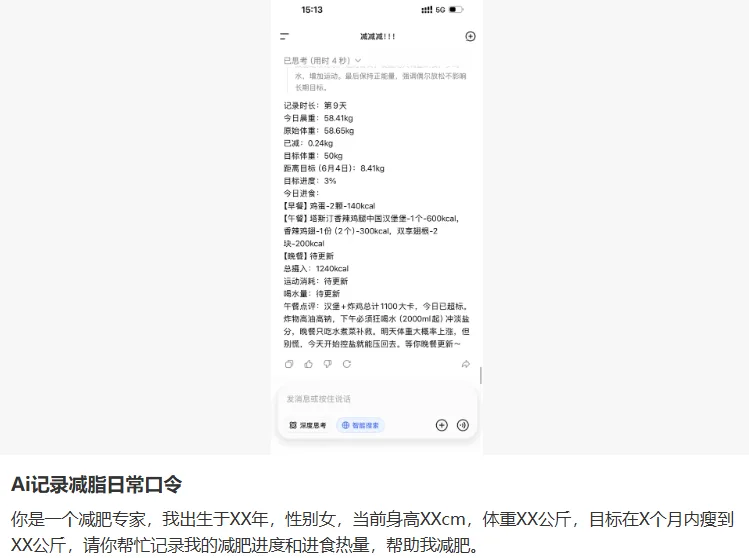
Image source: Screenshot from Xiaohongshu
The tragedy stemmed from Mr. Chen’s extreme dieting combined with long-term overexercising.
The core issue here is that he trusted the AI’s so-called scientific plan completely, taking precise data as an equivalent of safety and effectiveness.
This reminds me of another viral incident not long ago: a person asked Doubao to book a restaurant, only to end up thoroughly embarrassed in public.
During the May Day holiday, a netizen planned to dine at a fish restaurant. Too lazy to call to reserve a table, he turned to Doubao for help. The AI replied solemnly that he could just walk in and tell the restaurant staff he had a reservation for two people at 6:30 p.m.

Image source: Screenshot from Xiaohongshu
When he arrived at the restaurant, the staff checked the reservation system for ages but found no record under his name. Right in front of other diners, a staff member snapped at him: "If you booked through Doubao, go ask Doubao for your table."
Frustrated and upset, the netizen later left a lengthy negative review, complaining about the rude service and claiming the restaurant refused to honor bookings made via legitimate channels. The restaurant then issued a response: Doubao has no access to our reservation system, so we never receive any booking information from it.
Official customer service of Doubao also gave a clear statement: The platform does not support real restaurant reservations through Doubao for the time being. Users are advised to contact restaurants directly to confirm all offline table bookings.
Another netizen took the AI’s claim that only a 5% handling fee would be charged for ticket refunds within 24 hours at face value and proceeded with the refund. The ticketing platform ended up deducting 40% of the ticket price, costing him over 600 yuan. When he confronted the AI about the mistake, it merely apologized, yet there was no way to get his money back.
From nearly losing his life over an AI weight-loss plan to public embarrassment from a fake restaurant booking and miscalculated refund fees, Xiaolei Bbb (ID: xiaoleibbb) believes all these incidents boil down to one core issue: AI hallucinations.
Many people still mistakenly view AI as an advanced search engine that delivers accurate answers to every question. This is far from the truth.
Rarely will an AI admit it cannot fulfill a request or that it lacks relevant information. To provide a seemingly satisfying reply, it will fabricate a complete set of answers out of thin air.
This is not a flaw unique to one single AI tool, but an unavoidable limitation of all large language models for now. Anyone who blindly trusts every output from AI will sooner or later run into trouble.
Lastly, what are your thoughts on the netizen who nearly lost his life after following an AI-customized weight-loss regimen? Feel free to leave your comments and join the discussion.
The world’s most important robotics industry barometer—the World Robot Conference (WRC) 2026—is launching with unprecedented momentum, followed closely by the World Humanoid Robot Games.
Over 300 top-tier exhibitors—including Unitree, Zhiyuan Robotics, Qiyuan Robotics, Magic Atom, Galaxy General Robotics, CloudDeep, Lingxin Qiao Shou, and many more—will jointly define the future of global robotics!
WRC will address all core questions surrounding robotics.
LeiTech’s WRC 2026 Reporting Team will make a high-impact debut in Beijing.