
 雷科技
雷科技


























News on August 4: A trending topic left Xiaolei BIBI(ID: xiaoleibbb) utterly stunned. The female lead of an AI short drama charges 258,000 yuan for a 60-second advertisement.
To be honest, AI short dramas have been popular for quite some time. However, this is the first time we’ve seen virtual characters openly offer advertising services at fixed prices, with rates higher than those of real-life internet celebrities with millions of followers.
The viral female lead is Fang Taozi, a fully AI-generated virtual character.
She rose to fame through the AI short drama The Laid-off Girl, having made her debut merely 30 days ago.
Her Douyin account alone has gained over 400,000 followers, with likes approaching 30 million. Her follower growth outpaces many real-life content creators.
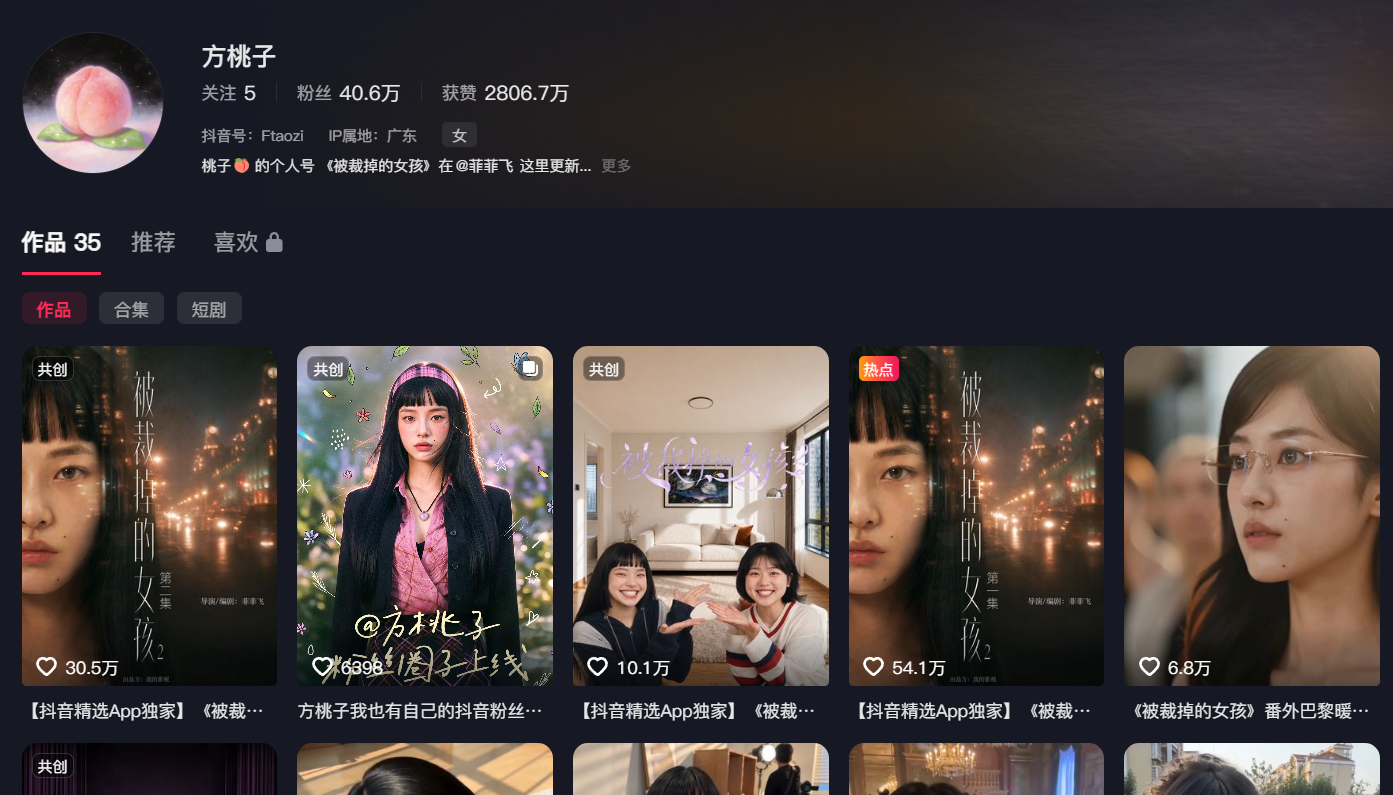
Image source: Douyin
Her account is now operated exactly like that of a real internet celebrity, featuring regular vlogs of shopping, working out and going to work, as well as so-called behind-the-scenes footage and daily routines after filming.
In Xiaolei's opinion, The Laid-off Girl truly delivers, as it managed to propel an AI character to such heights.
The drama follows Fang Taozi, a small-town girl who heads to the big city chasing her dream of becoming a model. She encounters layoffs, stolen opportunities and workplace setbacks along the way. Inspired by the creators' real-life experiences, it strikes a strong chord with young audiences.
The series has racked up over 200 million views on Douyin alone, and many viewers hail it as the pinnacle of AI short dramas.
Its greatest strength lies in minimizing the uncanny valley effect brought by AI-generated characters.
The female lead has moles, faint dark circles and visible skin texture. Her facial expressions and movements look natural, free from the stiff, distorted features seen in early AI works.
It is this rare lifelike quality that helped Fang Taozi quickly build up a highly loyal fanbase, laying the groundwork for subsequent commercialization.
What truly stunned the industry, however, is her commercial quotation.
According to Xiaolei, Fang Taozi has three fixed advertising price tiers: 168,000 yuan for 1–20-second short videos, 208,000 yuan for 21–60-second videos, and 258,000 yuan for videos longer than 60 seconds.

Image source: Weibo
Many real-life creators with millions of followers only charge tens of thousands of yuan for a single advertisement. Even numerous internet celebrities with tens of millions of followers may fail to hit the 250,000-yuan threshold.
Moreover, the price is not merely nominal. She has secured her first official advertising deal.
On July 31, Fang Taozi released a video featuring a built-in advertisement for a pair of colored contact lenses. She introduced the product features to the camera with camera awareness and speaking rhythm comparable to real beauty influencers, looking incredibly natural.
Frankly speaking, choosing colored contact lenses for promotion is a smart move. The category fits perfectly with her public image built on good looks, so audiences find the promotion seamless.
Though official statistics have not been released, the topic has already gone viral.
Some netizens may wonder: Is this the first case of AI live-stream sales?
The answer is no. Not long ago, Duan Yan, the male lead of another AI comic drama, achieved tangible results through product promotion.
In the comic drama Deep Love Penetrates the Rest of My Life, Duan Yan is a bona fide top-tier AI male character.
The same style bracelet he gave the female lead in the show was priced at 129 yuan. It sold more than 10,000 units on e-commerce platforms, generating total sales exceeding one million yuan.

Image source: Weibo
Brands pinned the clip of the male lead gifting the bracelet at the top for promotion, and fans flooded the comment section with order screenshots.
Even earlier, digital human livestreaming emerged. In 2025, Luo Yonghao’s digital avatar livestream drew over 13 million views, with GMV exceeding 55 million yuan.
These cases prove that AI-driven product promotion is far more than just a concept.
Yet it is Fang Taozi’s skyrocketing popularity that brought the trend to mainstream attention.
After the story hit trending searches, netizens split sharply into two opposing camps locked in heated debate.
Supporters argue this represents an irreversible major trend in the future.
AI characters will never suffer public image scandals. They have no private life controversies, will not throw tantrums or act arrogantly, are always available, and content can be revised and filmed around the clock.
What brands pay for is this controllability and security. Compared with real celebrities and influencers prone to frequent crises, virtual humans are a safer bet.
With well-crafted content that appeals to audiences, virtual figures can deliver comparable sales results while cutting communication costs and operational risks.
Opponents remain unconvinced. Their core objection is straightforward: can consumers trust recommendations from an AI that has never actually used the products?
The visual effect of colored lenses on eyes is AI-generated, without any genuine personal experience. Why should shoppers buy products endorsed by a virtual character?
Competition among real influencers is already fierce. Now AI is entering the market to vie for jobs, leaving ordinary people with shrinking room to make a living.

Image source: Screenshot from Douyin
From Xiaolei's personal perspective, I believe there is no need to overhype this incident nor dismiss it outright.
First of all, we have to acknowledge that the commercialization of AI characters boasts inherent advantages. Stable personas, zero risk of public image scandals, and high content output efficiency are unmatched by real people.
However, it is far too early to claim that AI can fully replace humans.
The authenticity, emotional value and unique personal charm of real human beings can hardly be replicated by codes.
No one can tell whether audiences will still pay for advertisements featuring virtual figures once the novelty wears off.
There are also practical compliance issues. Clear regulations are yet to be established regarding the boundaries of AI endorsements and whether such promotions constitute false advertising.
All in all, the rise of Fang Taozi serves more as a landmark event in the commercialization of AI.

Source: Douyin
It tells us that virtual characters are no longer merely a concept, but viable commercial IPs that can generate real revenue and gain market recognition.
We will most likely see a growing number of AI characters featured in short dramas, advertisements and live streams, competing alongside human creators.
Ultimately, only compelling content can sustain long-term success, regardless of the medium.
Now a question for everyone: Would you buy products promoted by AI characters? Share your thoughts in the comments.
The world’s most AI-centric, most tech-forward ChinaJoy has just concluded.
This year’s theme was “Journeying with AI,” and LeiTech MCN—specializing in AI hard-tech coverage—dispatched its first dedicated ChinaJoy reporting team to Shanghai. The results exceeded expectations. In 2027, LeiTech will significantly increase its investment in ChinaJoy.
Meanwhile, LeiTech’s WRC (World Robot Conference) 2026 reporting team has assembled, and preparations are underway for the largest-scale, highest-profile IFA 2026 reporting team in history—stay tuned!