
 雷科技
雷科技


























July and August are typically the hottest months of the year, and competition in the smartphone market in the second half of 2026 has intensified dramatically. Normally, August is when brands gear up for the flagship showdown in September autumn launches, with relatively few major releases. However, things are different this year.
Based on leaked information and official teasers compiled by Leitech (ID: leitech), the lineup of new phones arriving in August is fairly extensive. Highlights include the long-awaited return of the Huawei nova 16 SE, the well-rounded flagship REDMI K100 Pro series, and hardware-packed sub-flagships such as the vivo iQOO Neo11s. Furthermore, Honor Robot, the embodied smartphone unveiled at various exhibitions, will have its official launch, while the Google Pixel 11 will debut with the 2nm process.
This batch of new devices covers multiple price brackets ranging from mid-range models priced at two to three thousand yuan to high-end flagships. It also reflects trends including hardware-based artificial intelligence and the popularization of extra-large batteries. Below, we take an advance look at these August releases to see which one appeals to you most.
The Return of Huawei’s SE Lineup Targeting the Mid-range Market
According to industry leaker @Dingjiao Digital, a new Huawei nova series device codenamed "Cangshan" is set to launch. It is expected to be the nova 16 SE. Notably, the SE variant of Huawei’s numbered nova lineup has been discontinued in China for several years, with the last model being the nova 11 SE released back in 2023.
In addition, Huawei hosted a launch event for the nova 16 series on June 1 this year, unveiling four devices. Per leaks from @Wangzai Baishitong, the nova 16 series exceeded one million units in sales within 39 days after hitting the market. Such sales performance is highly impressive given the current market climate.

(Image source: Huawei)
The Huawei nova 16 SE is expected to be positioned slightly below the standard model, with a projected price range of 2,000 to 3,000 yuan. Leaks suggest it will come in four color options: black, white, orange and blue. Its core selling point remains photography, as the Red Maple Original Color Imaging technology featured on the Mate 70 series will be carried over to this device. Empowered by this technology, the nova 16 SE can deliver outstanding color reproduction even in extreme shooting conditions.
The Huawei nova brand has long targeted young consumers. Clearly, the nova 16 SE adopts a strategy centered on enhanced photography, trendy design and attractive pricing. It boasts strong competitiveness amid the ongoing wave of rising smartphone prices. Moreover, Huawei will host an all-scenario new product launch event on August 5. While the spotlight will be on the Zunjie new vehicle, the nova 16 SE is likely to be unveiled alongside it.
New Redmi Flagship Coming to Vie for the Title of All-Rounder King
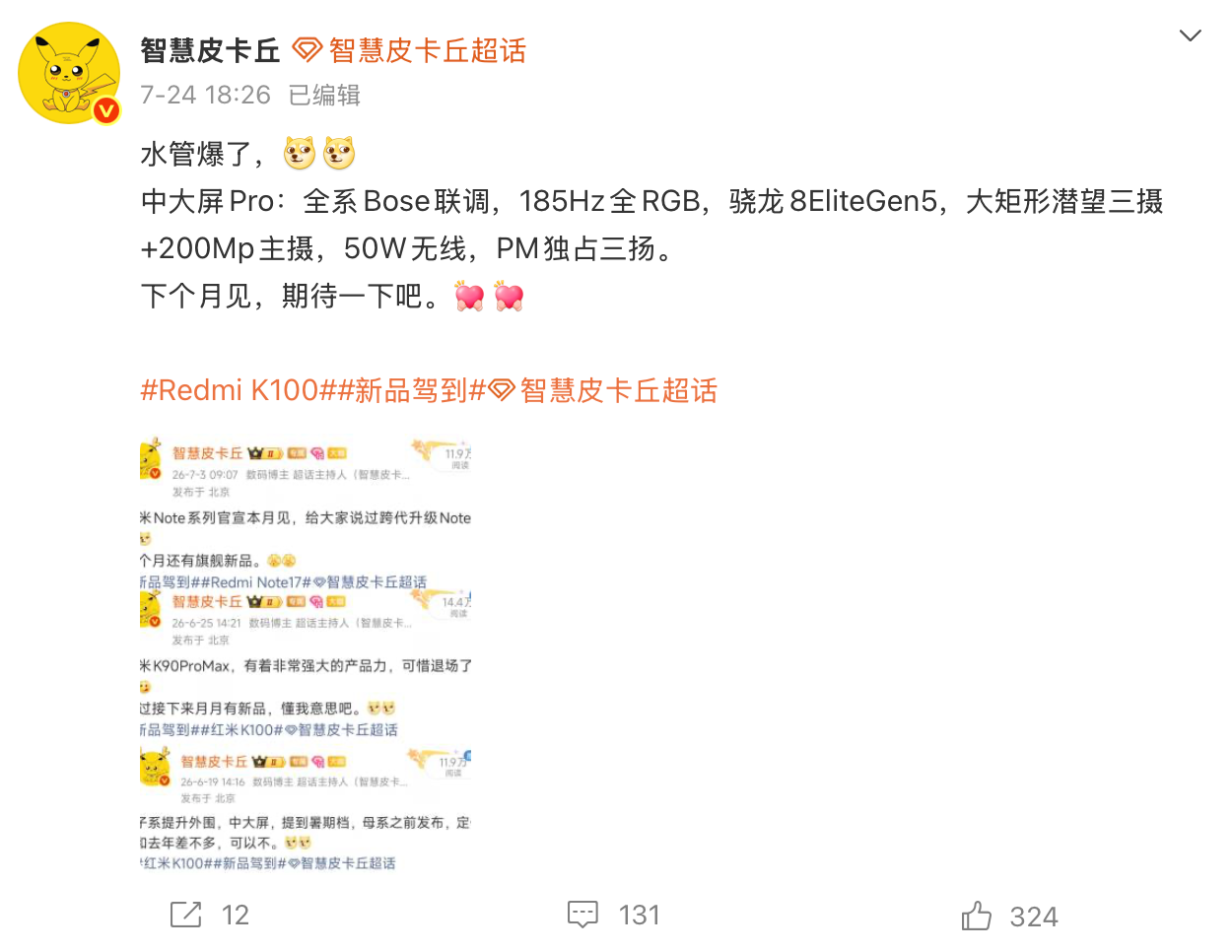
Xiaomi remained relatively quiet in the flagship market during the first half of the year, but it is set to launch a heavyweight product in August — the REDMI K100 series. Most specifications of the lineup have already been leaked. The K100 Pro will be equipped with the Snapdragon 8 Gen 5 Elite chip, a 185Hz high-refresh super pixel OLED display, a 200-megapixel triple rear camera system, 100W wired fast charging plus 50W wireless fast charging, and an 8500mAh battery.
Judging from its specs, the K100 Pro is a classic well-rounded flagship with top-tier configurations across the board, featuring no obvious weaknesses in performance, display, photography and other aspects. The K100 series also includes a standard version and a Pro Max variant, the latter packing an even larger 9000mAh battery.
(Image source: Weibo)
Now, the only remaining mystery surrounding the REDMI K100 series is its pricing. Faced with mounting storage costs, this new Xiaomi device is likely to see a price hike. Nevertheless, given Redmi’s positioning as a cost-effective brand, the increase should be modest. Furthermore, it is evident that amid cost pressures, Xiaomi has shifted its focus to high-end flagship models within its smartphone lineup, largely scaling back investments in many low-end entry-level devices, even at the cost of lackluster shipment figures.
By contrast, flagship models such as the REDMI K100 Pro offer room for maneuver in pricing and product refinement. They can serve as core offerings to retain target consumers and sustain brand visibility.
iQOO’s Sub-Flagship Targets the 3,000 Yuan Price Segment
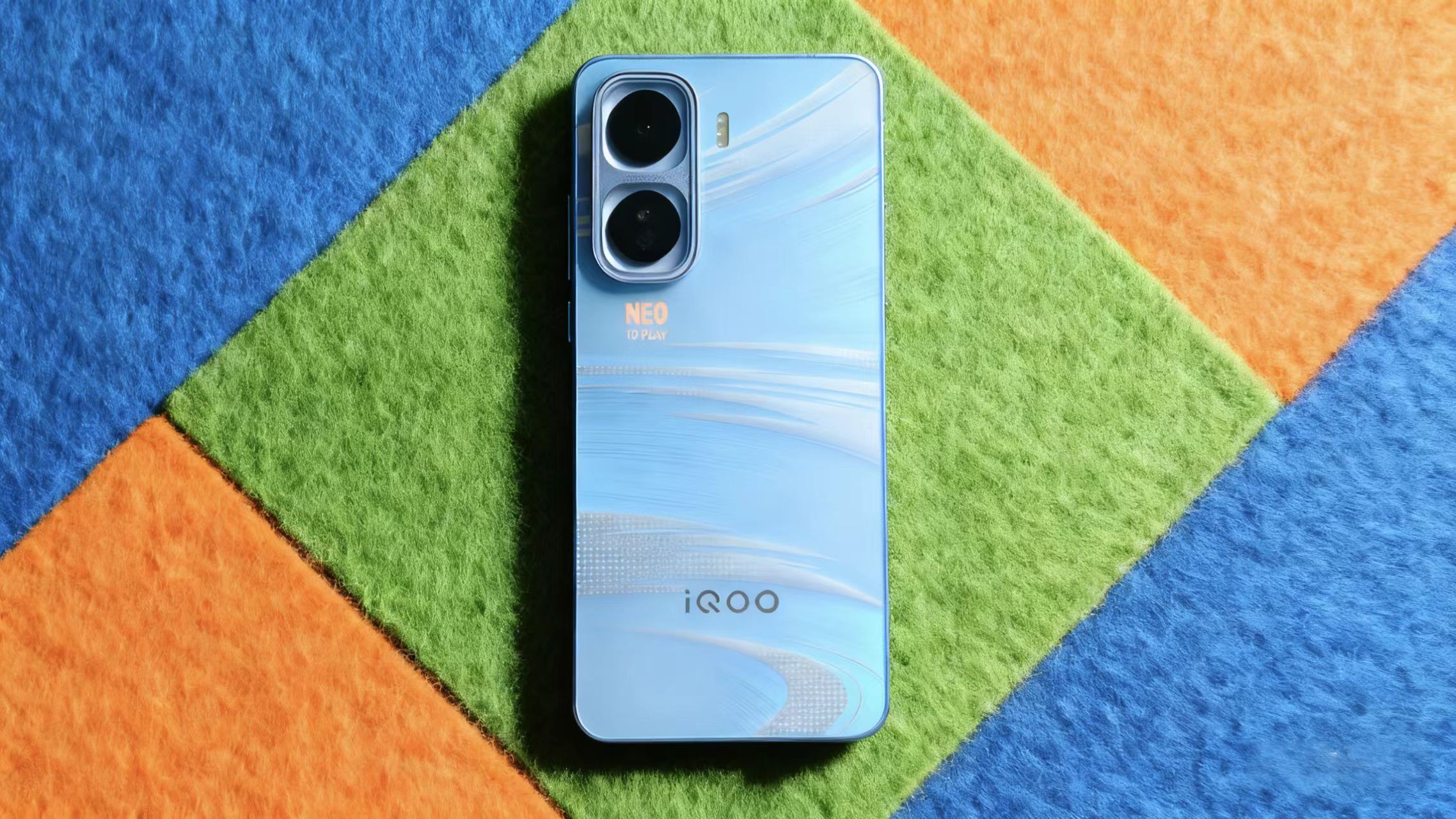
iQOO has long been a fierce competitor in the performance smartphone market at the 3,000-yuan price tier. Following the launch of the iQOO Neo11 last year, the iQOO Neo series will roll out a brand-new sub-flagship model around August, widely expected to be the iQOO Neo11s.
(Image source: LeiTech)
Based on current leaks, this new device is likely to feature a down-clocked Dimensity 9500 chip. Though it is a down-clocked variant, its overall performance remains solid. Paired with a maximum 16GB+512GB storage configuration, it handles high-load scenarios effortlessly.
Beyond performance, the iQOO Neo11s boasts generous specifications elsewhere. It comes with a flat 2K-resolution display and the well-received 3D ultrasonic fingerprint sensor. For battery life, it is equipped with a Blue Sea large battery exceeding 8000mAh alongside 100W wired fast charging. In addition, the phone achieves IP68/IP69 dust and water resistance, and will be available in three new colorways: Luminous White, Swift Shadow Black and Windrider.
This new iQOO model positioned at the 3,000-yuan tier follows a clear strategy: adopting last generation’s flagship chip to underpin its sub-flagship positioning. Naturally, competition at this price bracket will be fierce. With new flagship chips incoming and autumn launch events approaching, older flagship devices may slash prices to clear inventory and enter this market segment.
Honor Robot Phone Finally Available for Purchase
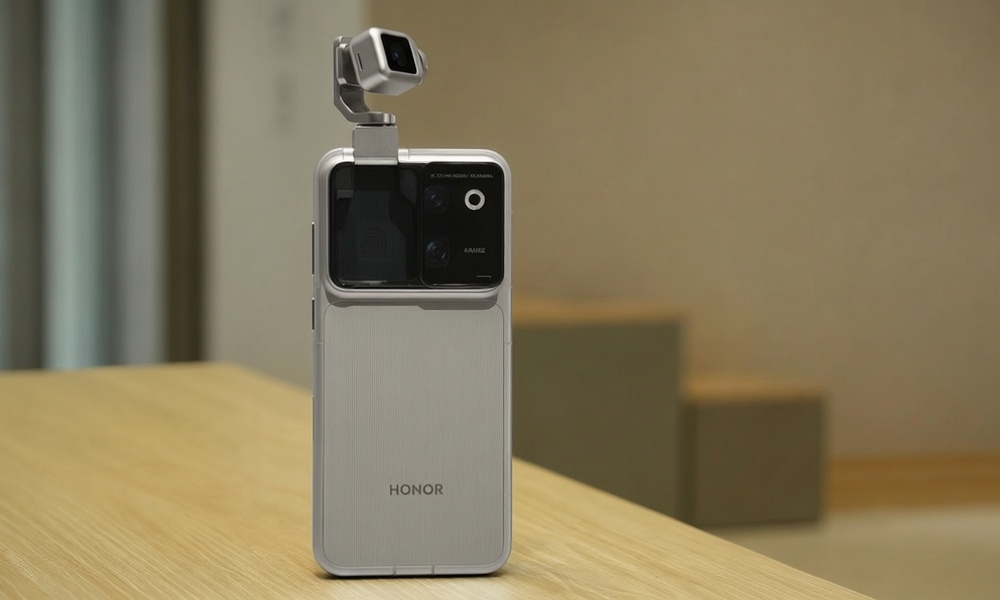
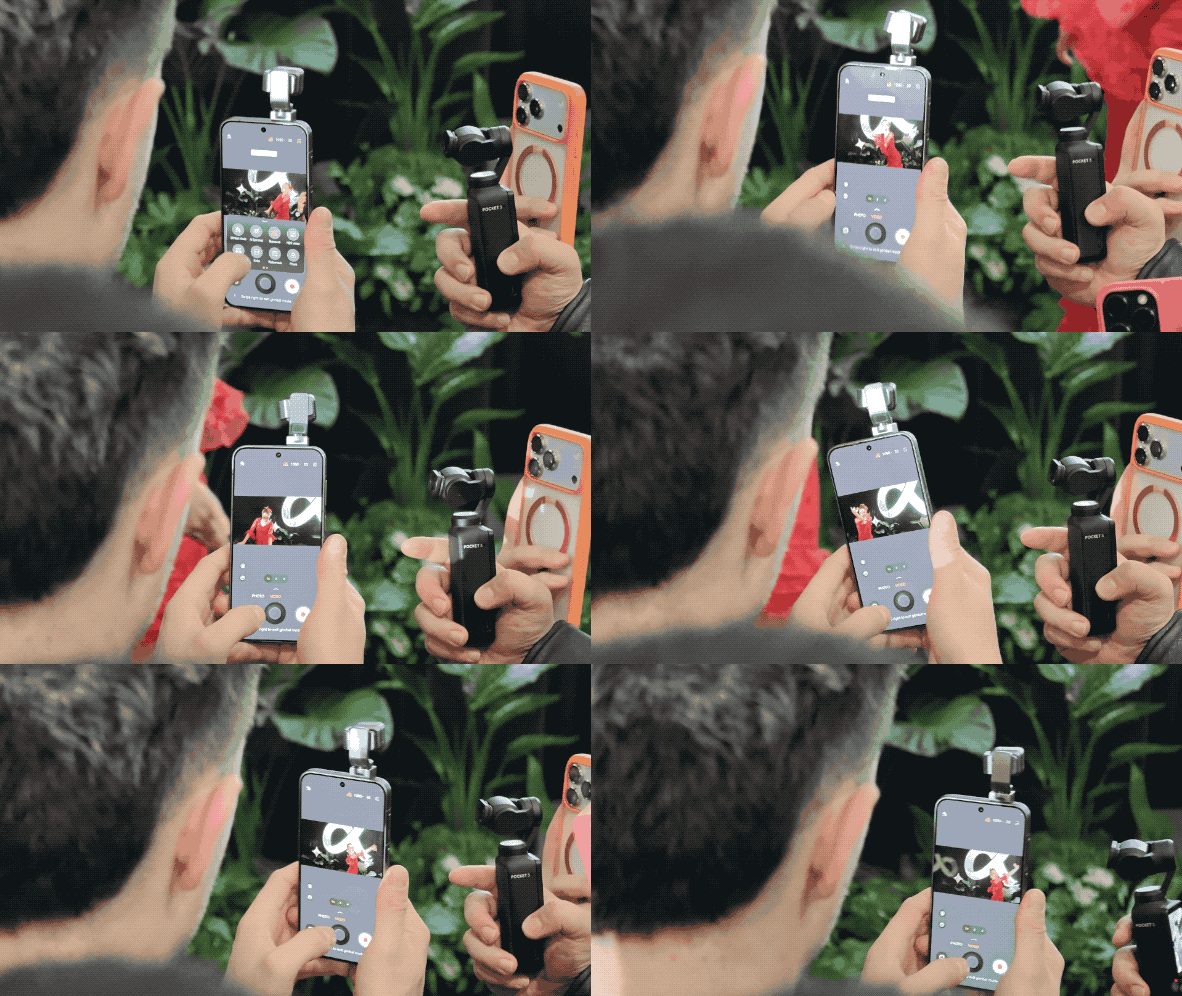
Honor Robot Phone made a stunning debut at MWC earlier this year and stole the spotlight. Its standout feature is a camera module consisting of a 3-axis mechanical gimbal stabilizer and a 200-megapixel sensor. Thanks to this mechanical structure, it combines embodied intelligence and photography capabilities.
It can track and focus on shooting subjects with greater precision. Furthermore, via unique AI interaction, it generates real-time dialogue responses based on external surroundings, granting the phone visual perception and transforming it into an AI hardware device.
(Image source: LeiTech)
Honor Robot made its first public appearance in China at the recent WAIC 2026. Now Honor has officially announced that the launch event for the Honor Robot Phone is scheduled for August 12. This means the smartphone will be released to the mass market. It also indicates that the Honor Robot Phone will enter mass production, so ordinary consumers will likely be able to purchase it.

(Image source: HONOR)
Information on the official poster reveals that this smartphone is jointly developed by Honor and ARRI. As we know, ARRI is the world’s leading manufacturer of cinematography equipment, and most commercial films are shot using ARRI camera systems. ARRI boasts profound technological expertise in imaging color rendition, light and shadow processing. The collaboration between Honor Robot Phone and ARRI is bound to deliver some pleasant surprises in photography performance.
Google’s In-house Chip in Pixel 11 Takes the Lead for the First 2nm Launch
Google has never been adept at keeping information confidential. When Google officially announced that the Pixel 11 series would be unveiled on August 12 (August 13, Beijing Time), nearly all details of the device had already leaked comprehensively.
Leaks suggest the Pixel 11 lineup consists of four models: the standard edition, Pro, Pro XL and Pro Fold. The base storage capacity across the entire lineup will be upgraded from 128GB to 256GB. All variants except the standard model will also offer a 1TB storage option.
Naturally, the biggest highlight of the Pixel 11 series is Google’s custom-built Tensor G6 chip. This processor will debut TSMC’s first-generation 2nm process, beating the Apple A20 Pro, Qualcomm Snapdragon 8 Elite Gen 6 and MediaTek Dimensity 9600 to market. For a long time, Google’s self-developed mobile chips have drawn constant criticism due to heat generation and energy efficiency issues stemming from manufacturing processes. Equipped with TSMC’s latest process, this pain point is expected to be fully resolved.

(Image source: X)
The CPU segment of the Tensor G6 delivers solid performance, featuring one ultra-large ARM C1-Ultra core alongside six C1-Pro cores. However, its GPU is relatively underpowered, adopting a PowerVR GPU released back in 2021, which falls short in both performance and energy efficiency by today’s standards.
Meanwhile, TSMC’s newest manufacturing process will push up costs for the Pixel 11 series significantly. Industry sources indicate that TSMC’s 2nm process costs over 50% more than its 3nm counterpart. Coupled with rising storage expenses, the Pixel 11 series will see a price hike of 100 US dollars. Furthermore, RAM capacities will be cut on some models. For instance, the base memory of the Pixel 11 Pro will drop from 16GB to 12GB.
Even so, the core selling point of the Pixel 11 series remains its Gemini-powered AI experience. Pixel devices have long served as Google’s testbed for various AI applications, marking a major advantage over other Android smartphones.
Kicking Off the 2026 Flagship Showdown: The Main Event Arrives in September
Looking at the new lineup launching in August, we can clearly discern each brand’s strategy for the third quarter.
Huawei aims to consolidate its mid-range market share by reviving the SE product line. Xiaomi and vivo (iQOO) go all out with hardware upgrades for their sub-brand performance flagships, seeking to capture young consumers in the 3,000-yuan price bracket with oversized batteries above 8000mAh and premium specifications.
Honor, for its part, brings what was once merely a demo device showcased at exhibitions to the mass market, centering its marketing on embodied intelligence technology. Google, usually a conservative player, is aggressively securing the debut of the 2nm process to build core competitiveness for Pixel via its custom silicon.
Nevertheless, Leitech (ID: leitech) believes that impressive as these August releases are, they are merely the appetizer for the second half of the tech industry’s year. On one hand, they act as a testing ground for manufacturers to trial new technologies and capture niche markets. On the other hand, they serve as warm-ups ahead of the upcoming September autumn launch season.
Bear in mind that September will witness the arrival of highly anticipated flagship products including Apple’s iPhone 18 Pro series and Huawei’s Mate 80 series — the true heavyweights of the industry.
If you are working with a limited budget and prioritize specific features such as ultra-long battery life or cost-effective gaming performance, the new August phones are solid choices worth buying. But if you have ample budget and crave a fully-fledged top-tier flagship experience, it may be wise to wait for the epic clash of industry giants in September.
ChinaJoy 2026—under the theme “Exploring with AI”—kicks off grandly on July 31.
A total of 900 entertainment-industry exhibitors—including Tencent, NetEase, Sony, Qualcomm, Maicong, and Qingxian—will jointly present a global feast for the entertainment sector.
How are AI-enhanced hardware brands—including terminals, peripherals, robotics, displays, and chips—collaborating cross-functionally with game-content developers to pioneer next-generation entertainment experiences?
Led by Founder & Editor-in-Chief Luo Chao, the LeiTech ChinaJoy 2026 reporting team will descend upon Shanghai for exclusive on-the-ground coverage—stay tuned!