
 雷科技
雷科技

























Are True Wireless Earbuds Getting Wi-Fi Connectivity?
vivo’s latest flagship true wireless earbuds, the vivo TWS 5 Pro, come packed with flagship specs: hybrid dynamic-balanced armature dual drivers, a standalone Hi-Fi DAC, and 60dB active noise cancellation. But the standout feature is its support for Wi-Fi lossless audio transmission at up to 4.6Mbps. While the function currently only works with select vivo devices including the X300 series and X Fold6, its transfer rate outpaces the 4.2Mbps of last year’s Xiaomi Buds 5 Pro Wi-Fi Edition — marking the highest wireless audio throughput among true wireless earbuds to date.
However, vivo uses a proprietary solution that differs fundamentally from Qualcomm’s XPAN technology found in Xiaomi’s earbuds, and deviates from Qualcomm’s broader vision for Wi-Fi-enabled audio wearables.
vivo’s Wi-Fi Earbuds Are Not the Same as Qualcomm XPAN
Per vivo’s official explanation, the TWS 5 Pro uses a point-to-point direct connection between the phone and earbuds. Wi-Fi lossless performance depends on the phone’s active WLAN status and frequency band, and enabling the feature occupies a portion of the phone’s WLAN resources. The earbuds do not connect to home or office Wi-Fi networks like smartphones or laptops, nor can they access the internet independently without the phone as a relay.
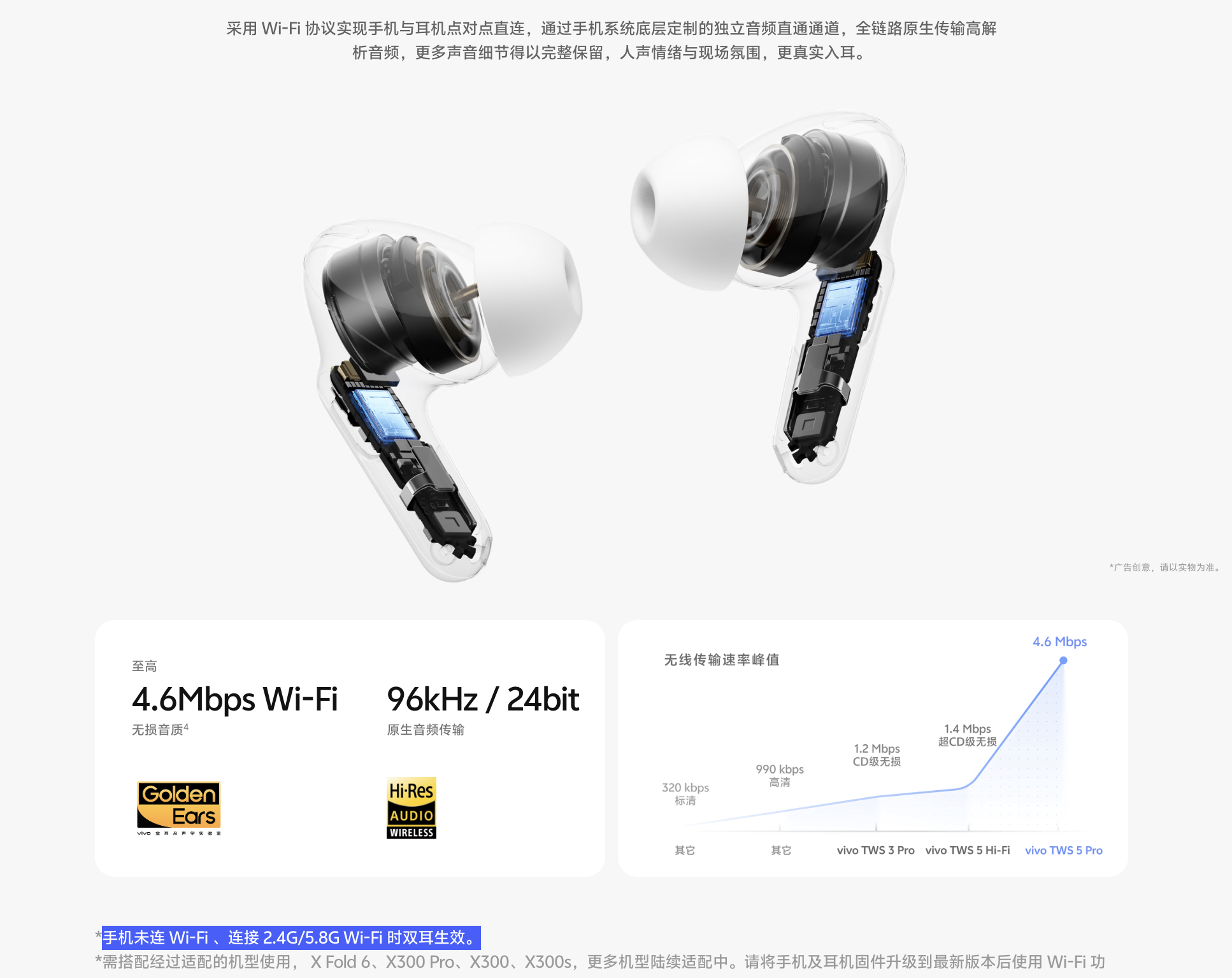
Image source: vivo
Put simply, vivo has merely replaced the Bluetooth audio link between phone and earbuds with Wi-Fi to solve Bluetooth’s bandwidth bottleneck. The smartphone remains the central hub of the entire experience.
Qualcomm’s XPAN (Expanded Personal Area Network) takes a different path. Leveraging ultra-low-power Wi-Fi for high-bitrate audio, XPAN lets earbuds connect to existing Wi-Fi access points, enabling uninterrupted music playback, calls and AI assistant access even beyond Bluetooth range. Bluetooth and Wi-Fi are not an either-or choice; the system dynamically selects the optimal link based on bandwidth, distance and power consumption.
More importantly, building on the same ultra-low-power Wi-Fi foundation, Qualcomm has introduced Direct to Cloud. Small wearable devices can gain independent IP connectivity and communicate directly with cloud-based AI agents, without routing every request through a smartphone.
Earbuds are simply the first product category to launch and the easiest for consumers to grasp. What is far more compelling to explore is what happens when Qualcomm extends this ultra-low-power Wi-Fi capability to personal AI terminals.
Aside from the Xiaomi Buds 5 Pro Wi-Fi Edition — the first true wireless earbuds to adopt XPAN — no other products using the technology have hit the market in the past year, making it look like a joint “experiment” between Qualcomm and Xiaomi. But in May this year, Qualcomm confirmed that more XPAN-enabled products are in development, and a next-generation XPAN is on the roadmap, set to debut alongside upcoming devices.
Judging by the timeline, more concrete announcements are expected at the Snapdragon Summit in late September. As a preview: Leitech has been invited to attend this major AI hard tech event in Hawaii, USA. Our reporting team will bring you first-hand updates, so stay tuned.
Xiaomi Built the First Product, But XPAN Hasn’t Solved Everything
Qualcomm first unveiled the Snapdragon S7 Pro Gen 1 audio platform with XPAN support back in 2023. Consumer products didn’t arrive until 2025, when the Xiaomi Buds 5 Pro Wi-Fi Edition became the world’s first XPAN-powered true wireless earbuds, supporting lossless audio at up to 4.2Mbps and 96kHz/24bit.
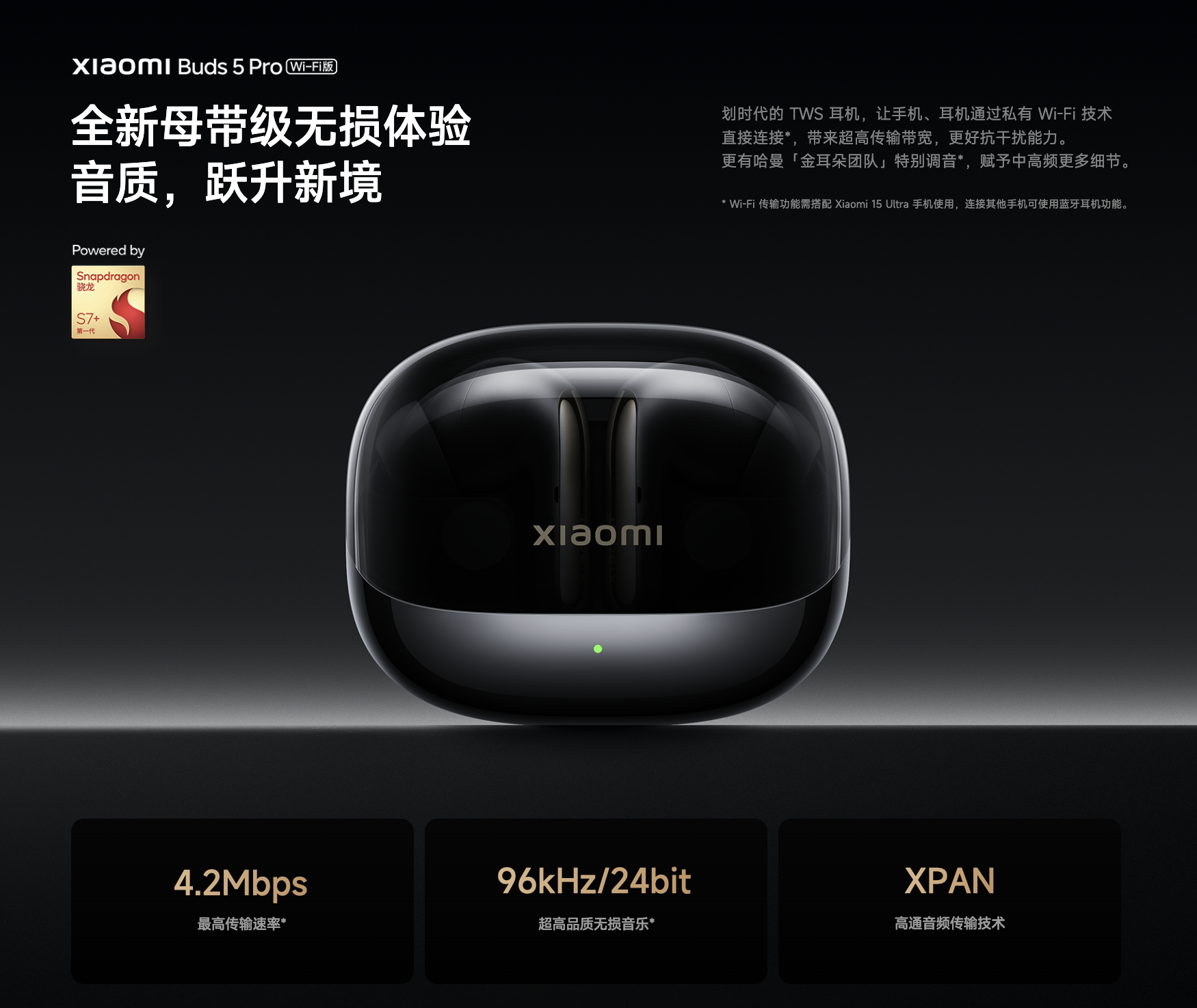
Image source: Xiaomi
Impressively, the Wi-Fi edition delivers 10 hours of battery life per earbud — at minimum validating the power efficiency of ultra-low-power Wi-Fi technology.
On paper, the Xiaomi Buds 5 Pro Wi-Fi Edition looks highly appealing. But compatibility is limited to newer models like the Xiaomi 15, Xiaomi 17 series and MIX Fold 4. For now, Xiaomi’s “Wi-Fi earbuds” still carry a strong experimental flavor.
Short for Expanded Personal Area Network, XPAN retains both Bluetooth and Wi-Fi with dynamic link switching: low-bandwidth calls use the more power-efficient Bluetooth, while the system switches to ultra-low-power Wi-Fi for high-bitrate lossless music or when users move out of Bluetooth range. It works with existing 2.4GHz, 5GHz and 6GHz Wi-Fi access points, with no need for dedicated router upgrades.
In short, Bluetooth’s strengths have always been low power, convenience and maturity, but it suffers from limited bandwidth and short range. Traditional Wi-Fi offers high bandwidth and wide coverage, yet is difficult to fit into true wireless earbuds designed for hours of continuous use. What XPAN aims to achieve is driving Wi-Fi power consumption low enough that the system can activate it only when the scenario justifies it.
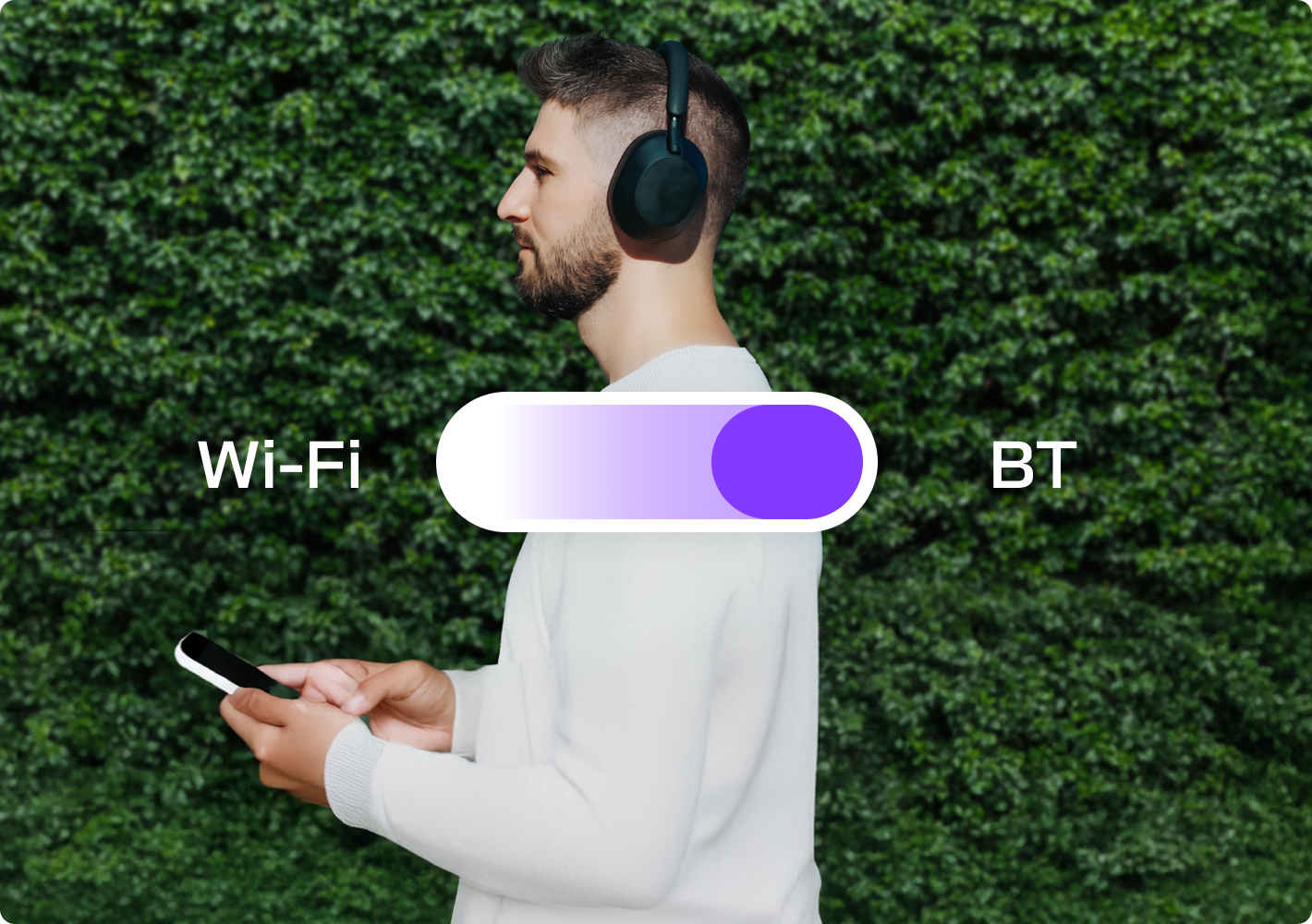
Image source: Qualcomm
Once fully realized, earbuds won’t have to choose heavily between low latency and high bitrate, and users won’t experience choppy audio on the second floor just because their phone is on the first. Qualcomm claims XPAN supports up to 24bit/192kHz lossless audio; when transmitting 24bit/96kHz lossless audio, its power draw is comparable to 96kHz lossy Bluetooth, and can be even more efficient at higher bandwidths.
To be fair, these capabilities have not been fully delivered on Xiaomi’s first-generation product. The compatibility gaps seen with XPAN are largely a symptom of a first-generation ecosystem still taking shape. Yet the bandwidth, range and power tradeoffs it addresses are long-standing, real challenges across the wearable industry. Earbuds are simply the most user-visible testing ground.
When Wi-Fi Matches Bluetooth’s Power Draw, Personal AI Terminals Go Always-On
At Lenovo Tech World @ CES this January, Qualcomm CEO Cristiano Amon highlighted a key connectivity technology when discussing next-generation personal AI devices:
“We’re enabling a breakthrough capability: running Wi-Fi at Bluetooth-level power consumption, so users can get an IP address even when away from their phone and maintain continuous connectivity to AI agents over cellular networks.”

Image source: Qualcomm
This statement carries greater significance than the raw bitrate specs of any Wi-Fi earbud.
Taken out of context, the remark can be misleading. What Amon emphasizes is gaining an IP address: small wearables will no longer have to piggyback on a phone’s internet connection via Bluetooth. Where Wi-Fi is available, they can connect directly to cloud AI agents. Of course, Wi-Fi will not replace Bluetooth or cellular — all three will work in tandem based on the scenario.
For over a decade, wearables have largely existed as accessories to smartphones. Watches, bands, earbuds and glasses connect to phones via Bluetooth and leverage the phone’s network and apps. The upside is low power consumption; the downside is equally clear: when Bluetooth drops, much of the “smart” functionality vanishes. Integrating a full cellular module, meanwhile, brings higher power draw, larger size, and a host of costs including data plans, certification and antenna design.
For basic fitness bands, this dependency may not matter. But personal AI terminals demand a fundamentally different mode of operation.
In Amon’s vision, devices like glasses, earbuds, necklaces and brooches will become personal AI companions. With user authorization, they will understand the environment and user intent, maintain continuous context, and respond instantly when needed. AI will run collaboratively on-device and in the cloud: on-chip processing handles wake-up, sensing and partial inference, while complex tasks are offloaded to cloud models.
This means connectivity cannot be a temporary link that only activates when the user opens an app. It needs to be available at all times — without draining the battery nonstop.
Ultra-low-power Wi-Fi fills exactly this middle tier. In homes, offices, schools and public spaces with Wi-Fi coverage, small wearables can obtain their own IP connection and exchange data directly with cloud AI agents, no phone relay required. When out of Wi-Fi range, Bluetooth, the phone or low-power cellular networks take over. No single connectivity technology solves everything; each network handles what it does best.

Image source: Qualcomm
This won’t free wearables from phones overnight, but it will reposition the smartphone from a mandatory middleman between personal AI devices and agents to a collaborative device.
Qualcomm’s Snapdragon Wear Elite platform, launched in March, has already built this vision into a full platform capability. Alongside ultra-low-power Wi-Fi, it integrates 5G RedCap, Bluetooth 6.0, UWB, GNSS and narrowband satellite communications. Each connectivity technology serves a distinct role: Bluetooth handles short-range low-bandwidth interactions, Wi-Fi delivers high-speed indoor transmission and cloud access, and 5G RedCap provides independent wide-area connectivity outdoors.
At COMPUTEX 2026 in June, Amon offered an even more concrete metric: Qualcomm’s technology has scaled down to earbud platforms with power levels below 2mW, enabling earbuds to connect to AI agents via ultra-low-power Wi-Fi.
If this technology matures, personal AI terminals will likely undergo three distinct transformations:
First, greater independence. AI glasses won’t need to route every object recognition request to the phone in your pocket. AI earbuds won’t just play audio from the phone — they will connect directly to the user’s AI agent. Devices will still work with phones, but they will no longer be mere wireless peripherals.
Second, seamless continuity. For personal AI to be useful, it can’t just remember the last question the user asked. It needs to understand where they are, what they’re doing, and tasks left unfinished on previous devices. Ultra-low-power Wi-Fi provides an on-demand, low-power always-on channel, allowing context from what glasses see, what earbuds hear and what watches sense to converge on a single AI agent within the bounds of user authorization.
Third, more flexible form factors. Historically, AI hardware makers have had to pick two out of three: connectivity, battery life and compact size. As connectivity power consumption falls, earbuds, glasses, pendants and even smaller wearables will have room to allocate battery and antenna space to sensors and on-device AI compute — or simply be made lighter.
Of course, technical feasibility does not guarantee product-market fit. Always-on connectivity raises heightened concerns around privacy, security and user consent. Home Wi-Fi coverage is not ubiquitous. And enabling cross-brand interoperability of connections, accounts and AI agents is far harder than fitting a chip inside an earbud.
Personal AI terminals need a more power-efficient, stable connection — but they also need a compelling value proposition that makes users willing to wear them long-term, share their data, and that solves real problems.
Ultra-Low-Power Wi-Fi Is the Next Big Leap for Wearables
XPAN’s commercial rollout has not been rapid, and the upcoming wave of products is certainly worth watching. But the focus of this article is not whether Wi-Fi earbuds will go mainstream. It is whether the underlying ultra-low-power Wi-Fi technology can be broadly adopted by small wearable devices.
When Wi-Fi runs at near-Bluetooth power levels, small wearables gain their own IP connectivity and can communicate directly with cloud AI agents via Direct to Cloud, no phone detour required. The phone remains a collaborative device, but ceases to be the mandatory conduit for all data and requests.
This will not spawn some “ultimate device” that replaces smartphones overnight. Wi-Fi coverage, cross-brand compatibility, privacy authorization, AI agent services and real product value — none can be missing. Ultra-low-power Wi-Fi only solves how to stay always-on; it does not answer why users need an always-on personal AI device.
Conversely, without low-power, stable and relatively independent connectivity, promises of “always-on”, “constant sensing” and “instant response” will remain nothing more than launch event concepts.
That is why what Leitech cares about most is no longer how much audio quality the next batch of Wi-Fi earbuds can deliver. The far more transformative shift is that earbuds, glasses and more personal devices will be able to connect directly to cloud AI agents without going through a phone. Wi-Fi earbuds are just the beginning. Whether personal AI terminals can truly take even a small step beyond smartphones may well depend on this connectivity layer that few have paid much attention to until now.